These posts are presented as a serialization that is best appreciated by starting with the first post HERE. You can then proceed in order by clicking on the HERE links shown in red at the bottom of every post.

If you enjoy these stories, please consider subscribing by email, or joining as a follower, both available in the right hand column below. You can also help spread the word by sharing a link with others.

Click HERE to see what the Wisconsin Historical Society has to say about “An American Downton Abbey.” You can also read about our inclusion in the society's 2010 publication, "Wisconsin's Own: Twenty Remarkable Homes," by clicking on the book's cover on the right below.

Jen Zettel's story for Gannett Wisconsin Newspapers generated a huge increase in page views! See what she wrote and follow the links to view clips of the interview HERE.

MORE MANSION, MILLIONAIRE AND GOOD LIFE PHOTOS TO BE ADDED SHORTLY.
Showing posts with label genealogy. Show all posts

Tuesday, February 19, 2013

In My Father's House


© Zane Williams 2010    

With one or two exceptions, the Havilah Babcock House looks exactly as it did in 1905 when my great-grandfather left town for Winnetka, Illinois - where he hoped to recover his health at a sanitarium but died of a heart attack instead. Since his death the principal change to the house is the back porch, which was added about a decade later to replace a small, enclosed stoop. Located directly off the kitchen, the more expansive porch overlooked Great Aunt Nell's formal gardens and was used exclusively for less ceremonial but fully staffed family dining in the summertime. The sleeping porch overhead came in response to the fear of tuberculosis which was sweeping the country at the time. Fresh air, particularly at night, was considered the best preventative, so for as much of the year as possible my great aunts and their widowed mother slept out there at the back of the house off the sewing room, on simple iron army cots. The cots are still out on the porch, but the luxurient gardens, a floral cornucopia which took two men to maintain, are now gone.


CHAPTER I, Part 9 

Depending on how liberal a definition one chooses to apply, the total number of mansions built in Neenah was just about forty. Another six or so built in Menasha (in spite of the tax implications at the time) could be reasonably added to the pot, as well as Tamagami, the 80-acre estate of F. J. Sensenbrenner that overlooked Lake Winnebago in the nearby Town of Harrison. Out of this total count more than a third of those in Neenah have been significantly altered, subdivided or even demolished. In Menasha the percentage is reversed: only a third are still standing. As for Tamagami (once considered the largest and most imposing estate in Wisconsin), nearly all trace of its existence is gone - the 44-room great house and its organ, both the formal and sunken gardens, the boathouse and its vast dancing pavilion, the huge garage and its underground tunnel to the house -  every piece of it gone but two roadside clusters of pine trees that at one time flanked the entrance gates (also on the list of grim fatalities).

In spite of these sad and in some cases tragic losses, the mansions of the rich have fared far better than the families that once occupied them. Out of what had been a substantial human inventory, a rough head count now shows that nearly half the leading mill families are no longer on the accounting ledger. The Stevens, Davis, Strange, Howard, Oborn, Hewitt and Kerwin families have all vanished without a trace. As for the others, only a small representative sampling can still be found in the local phone books - and even then it helps to know their married names. Few if really any live in the grand style their families once knew, and only three by my count in the mansions their forebearers built. Of these only one dates back to the glory days when Neenah emerged suddenly as one of the leading paper manufacturing centers of the United States.

And that one mansion is the house my father brought us to live in forty years ago.


     © Zane Williams 2010    

To this day the Havilah Babcock House remains much the way it was in the years following my great-grandfather's death. In the library, for example, only the gilt-framed picture of his beloved sister's very beautiful daughter, Ella Johnson,  is missing. The portrait hung to the left of the fireplace to balance the one on the right of the three oldest Babcock children. I suspect that Ella's picture was relegated to the attic by my great-aunts because Ella's life came to a tragic end, having died upstairs following a protracted illness, most likely after being abandoned by her husband. Her portrait, painted in the bloom of her youth, similarly came to no good end: shortly before her own death Great Aunt Betty got it down out of the attic and gave it to some distant cousins who turned the frame into a clock which they hung over a bar they had in their basement. They brought Aunt Betty over to see their handiwork and she was horrified but said nothing to indicate her continuing dismay over Ella's fate.


Spared the ravages of time and the quixotic dictates of good taste, the house built by Dad's grandfather, Havilah Babcock, avoided the fate of its contemporaries due to two factors. First and foremost, its construction and intensely attentive decoration was my great-grandfather's handiwork and his most satisfying accomplishment in life. Everything and everyone in it was all that mattered to him, not his work at Kimberly-Clark or his prestigious role in its founding. Surrounded by that powerful aura the house became the welcoming center in everyone's life, which in turn made it very hard if not impossible for his family when it came to altering or even rearranging things from the way their father had left them. The second important factor was that after Havilah Babcock's death his widow and their children for various reasons parted company with Kimberly-Clark as owners. Now, from one perspective this was a foolish decision, because in less than ten years the company began its trajectory into the stratosphere of consumer products, establishing a global identity and making all those still on board far richer than the four founders - or any of their families for that matter - could ever have possibly imagined. For the house, however, this decision to separate was a blessing. Severing ties with the paper giant left Babcock's wife and children with enough money to do what was necessary, but never quite enough to fall prey to the seductive power of changing fashions and mores, which in combination with great wealth most always proves architecturally lethal.

With each passing decade, marching further and further out of step with the times in the unchanging world of their father's creation, my great-aunts simply operated in a holding pattern for the remainder of their lives, never knowing in this shuttered existence that they would achieve almost as much recognition as came from founding one of the world's largest paper companies. For in 2010, the house and rooms they preserved - not simply as a museum but as a continuing way of life - were recorded with great sensitivity by photographer Zane Williams for the pages of "Wisconsin's Own," a Wisconsin Historical Society Press publication of the twenty most important homes in the state. There, alongside Frank Lloyd Wright's Wingspread, Milwaukee's Pabst Mansion, and Ten Chimneys, home of Broadway legends Alfred Lunt and Lynn Fontanne, was their father's house, the home they loved and protected, the only one still occupied by descendants of the original builder - the only place my father ever thought of as home.

But in telling you all this I've gotten ahead of the story. It's time I take you back to the events, as I gradually came to understand them, that led to my father's return to Neenah, the anointed prodigal son.


CHAPTER II begins HERE.


The above photographs of the Havilah Babcock House appear courtesy of the Wisconsin Historical Society. They were among those taken by Zane Williams of Madison for the Wisconsin Historical Society Press publication, "Wisconsin's Own: Twenty Remarkable Homes."  Further information on the photographer and the book are available through the above two links shown in red. More photos can also be seen in the Photo Album - "Wisconsin's Own" page.

Saturday, February 16, 2013

A City of Mill Owners


The impressive Alexander Syme House, built in 1882, is believed to have been designed by noted Milwaukee architect Edward Townsend Mix, whose work included Villa Louis and the Alexander Mitchell home (what since 1898 has been Milwaukee's prestigious Wisconsin Club). The Syme home's splendid isolation on Doty Island made this a spectacularly bold statement for the first mansion built on East Forest Avenue. Syme, however, was soon forced to sell the house when his highly profitable Menasha flour mill was condemned (for less than fair market value, Syme claimed) as part of a federal improvement project to that city's dam and waterpower. The Syme house was subsequently purchased by William Gilbert Sr., founder of the Gilbert Paper Co., whose own lucrative mill site was made possible by the federal rebuilding of the Menasha dam.


CHAPTER I, Part 8


Understanding Neenah's second neighborhood of millionaires requires a brief and painless geography lesson, followed by a small dosage of early history. So first the geography. At the northern end of Lake Winnebago, the Lower Fox River flows north out of the lake in two branches around roughly a square mile of land, forming what is known today as Doty Island.  Now the early history. Long occupied by various Native American peoples, settlement of the general area by Northern Europeans began first with Neenah on the south channel of the river. A few years later, a group of disgruntled founding settlers set up the rival settlement of Menasha on the north channel. Ultimately the two communities established municipal jurisdiction over their own one half of Doty Island, although Menasha had modest but more meaningful connection to it than Neenah. Menasha had two bridges across its channel, while Neenah had just the one until a second was constructed almost 100 years later in the 1950s.  

This MAP  of Doty Island and the surrounding area will help you picture what's going on here.

The significance of these geopolitical origins and linkages is that when Menasha aggressively pursued railroad development in the 1860s (envisioning its future as a major transportation hub), city leaders issued bonds to underwrite the cost of the local improvements, which in turn created an indebtedness that Neenah leaders had successfully avoided. The resulting threat of higher taxation in turn drove Menasha's leading industrialists to cross the municipal boundary into Neenah, where they built their homes on the tax haven side of Doty Island. In this way Neenah became known as a city of mill owners (and Menasha a city of mill workers), reputedly with more millionaires per capita than any other city in the United States - a claim no resident ever thought necessary to prove and no visitor ever considered worthwhile to challenge.

This second neighborhood of industrialists, like its East Wisconsin Avenue counterpart, extended along Doty Island's East Forest Avenue and was similarly clustered but generally with more land and open space between each of the homes.  Surrounded by woods and fields - with some farmland and orchards thrown in for good measure - the residents of this far more secluded neighborhood were able to build even more lavish homes than their counterparts across the Neenah channel of the river. Beginning in 1882 with the flamboyant Alexander Syme house, the distinct neighborhood character was established by multiple members of the Whiting, Gilbert and Smith families, all of whom were leading industrialists of Menasha. With one or two exceptions, most the houses built here were similarly designed by Oshkosh architect William Waters, more than half outfitted with the regulation tower.


While not on East Forest Avenue proper, the Whiting Boathouse is the most dramatic example of the more indulgent lifestyle enjoyed by the residents of that secluded neighborhood. Begun as a two-slip boathouse in 1932, Frank Whiting transformed the structure into a sumptuous Mediterranean party villa - complete with a rooftop terrace for dancing al fresco - while still in the very midst of the Great Depression. Show here circa 1939 with the original Nauti-Gal, a second significantly larger cruiser of the same name necessitated construction of a second floor over the slips to accommodate the second boat's much greater height. The remodeling, which took place in 1946, included a small apartment designated for the hired skipper, but which also reputedly outfitted a mirrored ceiling in the bedroom.


As a neighborhood well removed from the prying eyes in town - and perhaps more significantly its churches - residents of East Forest Avenue were generally less inclined to conform to the social norms as the more visible residents of East Wisconsin Avenue. A clear majority of Menasha industrialist living on the Neenah side of the island felt perfectly comfortable either changing wives with some regularity, or when widowed taking up with women that others viewed as their social inferiors. They and their families were similarly subject with far greater regularity to blackmail, breach of promise law suits, and even direct attacks on their persons and property. The second wife of Charles R. Smith, for example, was assaulted in broad daylight by a disgruntled Menasha Wooden Ware employee, while William Gilbert Jr.'s steam yacht, the Tia Juana, was torched and sunk at its moorings by a mysterious arson.

Such things were completely unthinkable on East Wisconsin Avenue.

The lawsuits and attacks on Doty Islanders may have been due in part to the neighborhood's relative isolation, but an equally valid explanation could have been the general inclination of these residents to indulge themselves in a far more conspicuously opulent lifestyle. Cars were one of the distinctions. George Whiting had not one but three limousines: a Rolls Royce, a Minerva and an Isota Fraschini. As for tennis courts and pools (both virtually unknown on East Wisconsin Avenue), Charles R. Smith's athletic daughter Sylvia installed a pool and tennis court when taking over her father's estate, to which she then added a squash court and the state's first privately owned indoor tennis courts. Further down the street and not to be undone, the Mahlers had a pool of filtered lake water created out an abandoned stone quarry - for which they hired a lifeguard and sent out engraved invitations announcing the designated times for general neighborhood use.

Frank Whiting, however, outshined them all, if not in substance than in style. In his backyard he created a preserve of Wisconsin flora and fauna, the later being made up of tame deer, raccoon, geese and at one time a small bear, which ended up getting loose and terrorizing the neighborhood. At the same time he turned his boathouse on the Neenah channel of the Fox River into a Mediterranean party villa, estimated to have cost when completed more than $100,000 in Depression era dollars. In addition to this he held onto his father's house just down the street from his own - maintaining gardens the senior Whiting had created on the lots opposite the house so they could be enjoyed from the front porch - commencing with his father's death in 1930 to his own in 1952.

And for much of that time the senior Whiting house was empty.


CHAPTER I continues HERE.


For more pictures and stories on the homes of Neenah's East Forest Avenue, as well as the Frank Whiting Boathouse, visit the Photo Album - The Mansions page.

Sunday, February 3, 2013

All In The Family


This photo is one of my favorites. It was taken on June 17, 1901 two doors down from our house at the home of John Stevens, to record the marriage of his daughter Jessica to Paul Kelley of Chicago. Mr. Stevens, father of the not-so-typical bride, stands guard on the right at the bottom of the steps, while the smirking happy couple look on from the stairs directly behind him. The other more sober-minded guests in this rare photo are members of Neenah's leading industrial families (as immediately apparent by the parade of hats that look like they might have been designed by Cecil Beaton for the Royal Ascot scene in "My Fair Lady"). Also on board are several Ilsleys of Milwaukee's Marshall & Ilsely banks, and a couple of Chicago Honorés, relations of Mrs. Potter PalmerThis was Jessica's third attempt at marital bliss, the first being to Harvard star athlete and University of Wisconsin head football coach Herbert Alward, who died tragically of typhoid fever in 1897. Left with an infant daughter, the young widow next married Gilbert Allis of Milwaukee, whose relations were among the founders of Allis-Chalmers Manufacturing Co. and the city of West Allis, Wisconsin. The union of Jessica and Gilbert, an elopement, ended a scandalous week after their return from a European honeymoon. Now here tying the knot yet again, Jessica had by this point a well-established reputation for being "wild" (she was said to have a developed taste for cigars). This, however, was no social hindrance to the elite well-wishers in the photo, who in reality had no choice in the matter when it came to their attendance. They nearly all believed themselves to be related to the bride in some way, even if they didn't know exactly how(See the Photo Album - The People page for a complete listing of all the guests.)


CHAPTER I, Part 6


In 1929 Hungarian author and journalist Frigyes Karinthy first posed the idea that everyone on earth was linked together in a chain of connection through no more than six other people. Some sixty years later his theory was popularized by the Pulitzer-nominated John Guare play, appropriately titled "Six Degrees of Separation" (and after that the celebrity parlor game, Six Degrees of Kevin Bacon). In a somewhat ironic illustration of the basic theory, both the John Guare play and the 1993 film adaptation starred Stockard Channing, who previously had appeared in the forgettable science fiction comedy, "Meet the Applegates," which in 1990 was filmed in Neenah right behind our house on Stevens Street (seen five minutes into the above YouTube link). 

Now here’s where it gets more interesting. During the filming my wife and I met Channing, through whom by only one degree of separation we became connected to John Travolta (with whom Channing co-starred in the 1978 movie "Grease"), by only two degrees to the late Princess Diana (who danced with Travolta at the White House in 1985), and by a third degree beyond that to Queen Elizabeth II, Prince Charles, Prince William, and - to those like my niece Hannah who fancy him - Prince Harry. The very lovely Middleton sisters are out one degree farther, and those of you who know me or my wife personally are only one degree farther still, well within the requisite six degrees. 

In Neenah the application of this theory expands exponentially due to the intermarriage of its industrial elite over five generations. Fortunately, the number of these families is discrete and easily enumerated. At the top of the pile - albeit by my own possibly biased ranking - are the Kimberlys, Clarks, Babcocks and Shattucks, due to their international presence in the founding of Kimberly-Clark. After that in less distinct order are the Gilberts and Whitings (who lived in Neenah but whose paper mills were located in neighboring Menasha), the Stranges and Menasha Wooden Ware Smiths (who like the Gilberts and Whitings were leading Menasha industrialists with established residency in Neenah), the Bergstroms (local stove manufacturers whose paper mill interests date from 1904), the Davises (who sold their mill holdings to the Bergstroms in that year), the Stevenses (John Stevens made his money in flour and then unthinkably retired at age 40 to enjoy life and spend his money), the lumbering Sherrys who shocked the town to its core by going bankrupt (divorce and murder were far more acceptable and less horrific crimes than losing money), and the Howards (whose fortune they bragged was based on buying and selling mills rather than operating them with any apparent skill or determination). 


Another of my favorite photos. This undated image appears to be a neighborhood - and by default family - Fourth of July picnic held behind the homes of Mmes. D. L. Kimberly and C. B. Clark. In all copies of the picture that I've seen, the man up on his feet serving coffee to guests (while the maids calmly attend to some business in the background) is consistently identified as my great-grandfather, Havilah Babcock. The subtext of the photo subtly illustrates how he stood out from other men of his era - and his popularity with women - stepping in here without ceremony to act as defacto host for two widowed relations. The number of circulating copies of this otherwise unidentifiable photo of him is interesting commentary in itself.


Historically later but of arguably greater significance are the Sensenbrenners (rising up in the ranks and leading Kimberly-Clark during its development of consumer products), and the Mahlers (who developed those products and quite wisely held title to the patents on them). Earlier but of equal significance for their role as the connective tissue linking many of these families together were the banking Hewitts, the millwright Oborns, and lawyerly Kerwins. Lastly, forming a comparatively lowly but still honorable rear guard were the knitting mill Jersilds, the banking Van Ostrand and Shiells families, and the merchantile Jandrey, Kellett, and Elwers people. 

Given Neenah’s relative isolation, it’s not surprising that Kimberlys were wedded to Hewitts, Babcocks, and Bergstroms, or that there were further multiple marital connections between the Babcocks, Hewitts and Bergstroms. Or that there were even more family ties linking these families to the Whiting, Davis, Smith, Clark and Sensenbrenner families, and through these linkages to the Stevenses, Gilberts, and Kerwins - and from them additional loops back to the Babcocks, Smiths, and Kimberlys, to provide only the briefest synopsis of the genetic complications that had been created.  

The genealogy was so complex that when the Manufacturers' National Bank of Neenah opened the city's first trust department, the secretary hired on was strictly instructed not to talk about anyone. Period. "Whoever you're talking to will be related to whomever you're talking about," she was advised. Mabel Kimberly Gilbert - my second cousin twice removed who was genealogically speaking a Kimberly, Hewitt, and Gilbert - was more blunt and to the point. At the far side of eighty when I interviewed her, she was sharp as a tack and had a deliciously wicked sense of humor. 

"It's a miracle we weren't a lot stupider than we were." 


CHAPTER I continues HERE


Saturday, January 19, 2013

A Promise Fulfilled


Aunt Nell and Aunt Betty in the Gold Room with their friend Mary Orbison wearing a dress from one of the trunks in the attic.  The photo was taken to publicize a home tour in the 1960s benefiting the local chapter of the American Association of University Women, of which Aunt Nell was a founding member.


CHAPTER I, Part 4


While Aunt Fan may have won us over completely during our visit to Neenah, Aunt Betty was no slacker in seeing to it that her guests were properly entertained. She had organized a trip for my brothers out onto Lake Winnebago in a speed boat, as well as a visit to one of the local paper mills to see how paper was made. As I was considered too young for either one of those activities, a play date had been arranged for me with a local boy my age whose family was known to Aunt Betty through the First Presbyterian Church, where she and Aunt Nell were life members. And when it was learned that a tour had taken place at Aunt Fan's (albeit primarily for Mom’s benefit), there was nothing but that Aunt Betty would lead a similar tour of for us boys.

Only odd fragments of that tour come back to me now some fifty years later, and then only in images that no longer retain distinct focus. Most of them center around the parlor, which with its gold damask upholstery and gilded chairs was appropriately called the Gold Room. Dad said he always referred to it as the "padded cell" because the wainscoting was entirely comprised of tufted brocade. As an accomplished artist Mom expressed an equally jaundiced opinion (although not within Aunt Betty’s earshot), finding fault in the bird and a nest of eggs depicted in one of the pastoral scenes of the hand-painted Limoges fireplace tiles.

“It looks like she laid her eggs in some old tire,” Mom said.

Unlike Aunt Fan’s where everything was new and beautiful and expensive and untouched, here the items in each room had a story, and because of that they were great family treasures, regardless of monetary value or condition. Even the broken cut glass globe in the parlor chandelier - the pieces anchored back together at great expense with tiny copper rods - had a story, having been shattered by Dad with a tennis racket while trying to kill one of the many bats that plagued his aunts’ lives each year. The majority of stories, however, came back without fail to Aunt Betty’s father, who had built the house in 1883 and had died more than ten years before Dad was born. “Father always insisted,” Aunt Betty would begin, inevitably ending the anecdote with some reference to the economic value of waiting to buy, and then only the best quality available, the savings being in buying only once in a lifetime - or in this case two. As a result, little if anything of significance had ever been changed.

Far clearer in my mind are the vivid images of what Aunt Betty showed us in the attic. Led up past the maids’ room into a secluded gable, she opened one of more than a half dozen battered old steamer trunks, all covered with stickers of ocean liners and exotic ports. And then searching through this drawer and then that one, she showed us a succession of sacred marvels stored there: her father’s stiff shirt collars and collapsible opera hat, and dresses from her mother’s wedding trousseau, made up of yards and yards of fabric and never worn due to a death in the family. There was even a box of civil war bullets and canon balls ploughed up at the Appomattox farmhouse of a distant cousin. The rest of the attic was similarly crammed with even more treasure, including the side saddle from Aunt Nell’s equestrian days and the cradle each newborn in the family had used, as well as all manner of other hulking mysteries, each of them covered humps of old sheets and grey canvas, a herd of dozing pachyderms.

It was also later that same day that I had the strangest experience of my life. It was in the early evening and somehow I had wandered out unattended onto the verandah. There, standing by the tower, I was listening to the city band playing in the park across the street, when suddenly I was overwhelmed by a single complex thought that came into my head as though being spoken directly into my ear by many voices, not with words so much as just the emotion and meaning behind them. At the same time it was a sense of total being and connection, of feeling surrounded and embraced, a comprehension that standing there was something right and good and meant to be, the fulfillment of something promised. It was a strange sensation, but not one that was frightening. In fact I remember being washed over with a sudden calm, even though my arms and legs and neck were tingling. And then just as quickly it was over, gone, and I went inside and told no one about it until now.

The next morning Dad packed us back into the station wagon to continue our travels, ladened with chicken salad sandwiches, potato chips, and bottles of 7-Up, all thoughtfully boxed and wrapped in wax paper by the cook and brought out to us at Aunt Betty's direction. As we turned out the driveway Mom settled in for our third and final reading "Thunderbolt House," and as we drove off no one looked back but me, from my lowly position in the family hierarchy, out the rear hatch. The weekend was quickly put behind us, and there was no discussion of ever returning.

But we did.


CHAPTER I continues HERE

Saturday, January 12, 2013

Had We Ever Been Allowed


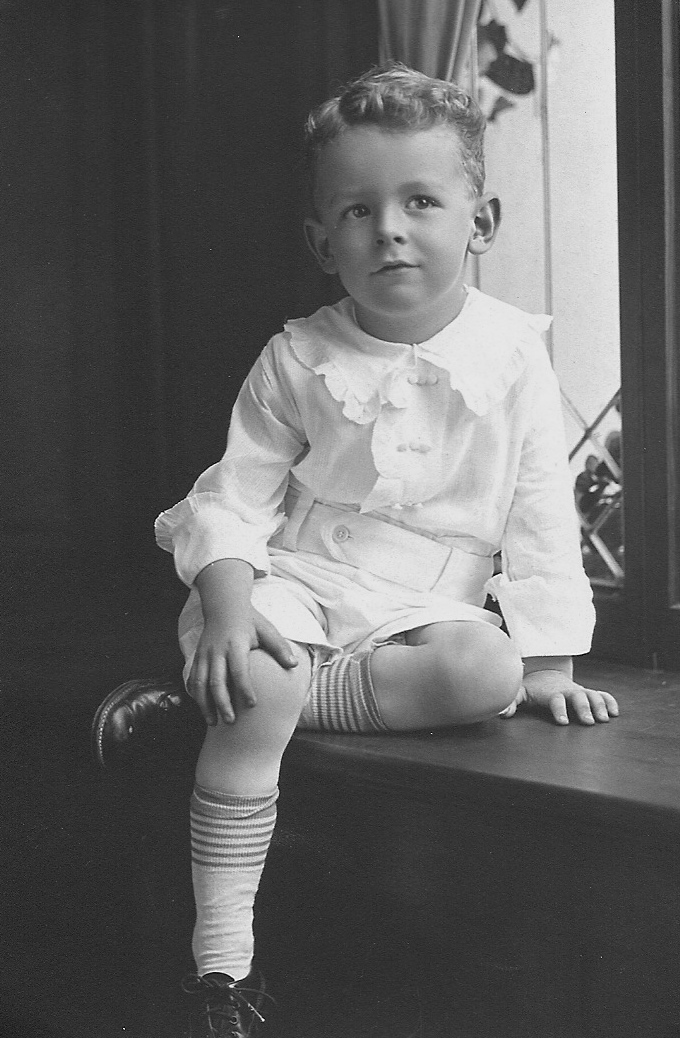
   Dad, a poised four-year-old with the first glimmerings of rebellion in 1920.   


Chapter I, Part 3


On our first full day as visitors in Neenah Dad took us out to see the carriage house, what the family called the barn - perhaps because its sole purpose had been to house horses and cows (and at one point a substantial flock of chickens), the carriages and sleighs having been kept elsewhere when not in use. Dad showed us the stables and tack room, where the oats were stored and the hay was kept, and the little fenced area behind the barn which was always referred to as the cow yard. In the process he inadvertently offered up a glimpse of some of the happiest, sun-filled memories of his boyhood. He never spoke about himself at home, but here in Wisconsin he showed us where he had nailed lath inside the abandoned hay chute to make a secret ladder up to the loft, and he talked about how in his teens he had surreptitiously scaled the tower of the house by rope, just to prove to himself that he could do it.

Dad also recalled a terrific electrical storm during one of his many extended visits. He was about twelve-years-old at the time and was up in the house with his mother in the boys' room, one of the bedrooms in back where his Uncle Harry and Uncle George had slept as children and which Dad was sharing then with his mother. The storm had come up as she was in the process of explaining the facts of life to him, and with a sudden clap of thunder a simultaneous bolt of lightening knocked the chimney off the barn. The electricity then powered down the barn's wiring to an inside faucet where the hired man was taking a drink. The electricity threw this poor fellow and his metal drinking cup across the stables, leaving him disoriented but unhurt, after which the electricity then jumped over to the horse stall where the window and porch screens were being stored, punching holes through all 117 of them.

"You don't forget a day like that" Dad said. This one comment was the closest he ever got to having the sex talk with any of his boys, a task he left to our mother. Had I known at the time I would have paid more attention.

Later that same morning we were scheduled to go down the street to visit Dad's Aunt Fan, the much beloved widow of his Uncle Harry. Not having had any children, Aunt Fan and Uncle Harry all but adopted several of their nieces and nephews, or at least so it seemed to the adoptees. In Dad's case Uncle Harry was his namesake and as such he stepped into his nephew's life as Dad's father traveled the country seeking diagnosis and treatment for the early onset of Alzheimer's disease, a nearly unknown disorder at the time that was swallowing him up whole. When Dad's father died in 1929 Uncle Harry's role in Dad's life grew even more significant, but then only briefly. A little more than a year later Harry died as well, unexpectedly, of a massive heart attack. After that there was no one else in Dad's life to take his place.


   The home of Harry and Fanny Babcock, as seen from the gardens, circa 1930.   


In our departure to see Aunt Fan (who had continued living in the sprawling house she and Harry had purchased in 1912) there was a good deal of murmuring and worried looks from Aunt Nell and Aunt Betty. In the car Dad explained that Aunt Fan was 82 and had not been well, and that the aunts thought she was unwise in attempting to entertain us. The facts were sufficiently gruesome to require an explanation and renewed warnings about our best behavior, accompanied by an admonition not to stare. Aunt Fan was not only confined to a wheelchair, but was required to wear a body brace, having bones so brittle that she had broken her back from simply trying to open a window, or so Dad said. She also had one leg that was grotesquely swollen, an edema that Dad diagnosed with astonishingly inaccurate medical authority.

“Elephantiasis,” he said. “She got it down south in Charleston.”

Given this introduction, it was hard not to stare when Aunt Fan finally came rolling into the front hall of her house - particularly since she made her entrance out of what at first appeared to be a closet but was in fact no less than a personal elevator. With all eyes on Aunt Fan, the body brace was clearly visible under her dress, and one leg was obviously more than twice the size of the other and very much like an elephant's. Seeing the look of horror on our faces, she tapped on the steel hidden by her dress and winked at my brother Steve. “Go on. Give me your best punch,” she said. “I’m tougher than Superman.” Mom alone was shocked by this, fearing I suppose that Steve might take Aunt Fan up on the challenge, but the joke put everyone else at ease. As old and as rich Aunt Fan as may have been, she had a keen understanding of people and human nature, which made it easy to see why she was so beloved.

For her share of our visit, Aunt Fan planned on taking us out to
North Shore Golf Club. Uncle Harry had been involved in the creation of North Shore just before his death, and it was one of several Aunt Fan still belonged to in spite of her physical condition. She had booked a private room there for our lunch and - we discovered - instead of set meal had arranged for us to order anything we wanted from a menu that very thoughtfully included hamburgers and hot dogs. Before that, however, she insisted on showing Mom what she had done with the house, having recently redecorated to the latest Architectural Digest standards in spite of her age and infirmity, simply because she could. The tour of impeccably furnished rooms drew very little interest from my brothers, but on the second floor, moving from bedroom to bedroom, none of which appeared to have ever been occupied, I saw Aunt Fan turn to Mom and gesture to the unused accommodations.

"This is where you would have stayed," she said, "had you ever been allowed."


CHAPTER I continues HERE

Saturday, January 5, 2013

The Misses Babcock


Miss Helen Babcock, seated, on her 80th birthday in 1953, with her sister Miss Elizabeth Babcock - my Great Aunt Nell and Great Aunt Betty. The simplicity of the photo nevertheless illustrates the complexity of their sisterly relationship, as seen in their expressions and body language.


CHAPTER I, Part 2

While we were out on the road on our cross country trip, Mom had read aloud to us from "Thunderbolt House" by Howard Pease, a Hardy Boys style mystery so captivating that vast stretches of each day passed with only the sound of Mom’s voice and the turning of pages. Through two complete readings back to back, plus a third on the return trip home, we listened to how the life of a small town California family in the early 1900s was transformed by the inheritance of a San Francisco mansion, how each member of the family was brought down by the their ascent into Nob Hill society, and how the only thing that saved them was the earthquake and fire that destroyed the city in 1906.

And so now here we were in Wisconsin, the book freshly closed and set aside, walking up to the door of a mansion as every bit a mystery as the one on the cover.

Ushered inside by a uniformed maid, we passed through heavily upholstered rooms with high gilded ceilings and brocaded walls into the presence of my father’s Aunt Nell and Aunt Betty, or - as they were locally known with grammatically archaic formality - the Misses Babcock. Tiny and stone deaf at 88, Aunt Nell was the first born, oldest living, and long established matriarch of the family. She had ridden a camel in Egypt, taken to the skies as a passenger in one of the first flying machines, and unlike most of her contemporaries had committed much of her life to helping those in need, and to giving unstintingly to all manner of community projects that a town the size of Neenah would not otherwise expect to enjoy. In sharp contrast, her taller but diffident sister Betty was the 79-year-old baby of the family who had spent most of her life under her sister's wing, supporting Nell's good works and taking care of the home.

Neither lady was more than dimly familiar to me as an eight-year-old, but their presence in our lives was far from remote or shadowy. At our great distance away in California we had been showered each year with a formidable array of Christmas gifts, and as each of us turned twelve these Wisconsin ladies marked our transitions into adulthood by substituting presents with an annual check made out for a manly $25, a sum so substantial and impressive at the time (Mom and Dad were given a joint $75) that opening a savings account followed without protest.

Every two or three years the aunts would also come out to San Francisco, at which point we would all be washed and dressed and taken into the city and briefly put on display for them at places like the
Mark Hopkins or the Fairmont or the Clift Hotel, institutions of such luxury and privilege that the visits were more like stereopticon views of foreign lands, vaguely distorted and so removed from our own time and way of life that they were easily set aside or forgotten, except as some passing curiosity. It never really occurred to those of us on display that the lives of these ladies were in any way umbilically connected to ours.

Occasionally the two of them might alternately come to our house as part of some larger family gathering, for which Mom would dedicate months to properly stage, first cleaning and reorganizing every corner and cupboard of the house, then preparing an elaborate meal inevitably using the entire Royal Doulton china service Aunt Nell and Aunt Betty had picked out with her at
Gump’s of San Francisco, their present to Mom when she married Dad. And when finally welcomed into our home with all the solemnity of visiting heads of state, the two sisters would very kindly comment on how perfectly everything had been arranged, and Aunt Betty in particular would remark on the dinner, noting that she was unable to get their cook to fix more than one vegetable and here Mom had prepared three.


My father, Henry Babcock Adams, walking my oldest brother Bob along the Neenah shoreline during their visit in 1941.  The tension that existed between them all their lives was clearly evident even then.


Mom, however, was certain that both Aunt Nell and Aunt Betty disapproved of her, recounting repeatedly as evidence the events of her first and only other trip to Wisconsin, which had taken place in 1941 when my oldest brother Bob - newly married at the time of our trip - was a rambunctious two-year-old. At lunch on the first day of that earlier visit Mom had taken Bob out of the ornate Victorian high chair that had been set up for his use and let him run around the dinner table as the adults continued to talk. She then took him upstairs to change his diaper and to her horror discovered that while the diaper had been soiled, it’s contents had escaped to parts unknown.

How the errant turd escaped from both the diaper and Bob's clothing remains a mystery, but during her ensuing search of the intricate patterns of oriental carpets and parquet flooring, Mom was approached by Aunt Betty who readily offered to help, assuming the hunt was for nothing more offensive than a missing earring. When apprised of the real objective, Aunt Betty turned white, then quickly mustered all available hands into a bucket brigade outfitted with mops, pans, cleaning fluids and flashlights. Eventually the wayward excreta was found on the dining room carpet, remarkably untrammeled given the number of parties involved in its recovery. And shortly thereafter, to Mom’s everlasting chagrin, a nurse was hired to take charge of Bob for the remainder of their visit so that Mom could relax more during her stay. From this Mom inferred that she had been cast as nothing less than an unfit mother.

Now some twenty years later there were four children in tow, all seated in that very same dining room around a table set with linen, china, crystal and sterling, being served fried chicken by a procession of maids in white organdy aprons, each carrying some part of the meal on silver platter perched upon little white cushions trimmed in tatted lace. Sitting next to Mom, I mumbled something about wanting ketchup and was shushed with a little more emphasis than I had normally come to expect. Moments later, however, a tiny silver pitcher of the stuff was set at my place, summonsed through the oracle of Aunt Betty’s attentive ear and a buzzer to the kitchen hidden under the carpet.

And while it seemed to me in the moment that nothing could have been more amazing than that little pitcher of ketchup, when the dinner dishes were removed each place was next set with a finger bowl of warm scented water, for any of us who might have used our fingers to pick up a chicken wing or leg. This fastidiously thoughtful interlude, preceding the apple pie and cheese, was no less astonishing and exotic to me than had a band of whirling Dervishes come spinning around the table.

I had never seen anything like it before - and never would again.


CHAPTER I continues HERE

Sunday, December 30, 2012

The Journey Begins


The Havilah Babcock House circa 1908, Neenah, Wisconsin.


CHAPTER I, Part 1


In 1962 when I was eight years old, my family set out on a cross country road trip from our home north of San Francisco to the East Coast and back. Mom, Dad, me, three older brothers and a yellow Pontiac station wagon. Bill, a sophomore in college, sat up in front and took turns driving with Dad, while Dave and Steve, both in their teens, divvied up the window seats in back with Mom. As the smallest and least significant, I rode behind everyone else with the luggage, where the only unobstructed view was out the rear hatch. From this position in the family hierarchy I seldom had any idea where we were going but always had plenty of time to think about where we had been and what we were leaving behind.

Dad’s original idea in taking this trip was for us to see the country, only once we were out on the road making good time became more important than having one. “We can always see that kind of thing on the way back,” he said about Yellowstone and the Badlands, both of which had been vaguely promised but were no where near the route we were on. Driving each day until the dead of night, we stopped only at greasy cafés and dusty gas stations until finally, pushed to the brink of exhaustion, Dad would turn in at some dimly lit roadside motel where the neon vacancy sign flickered ominously. As he walked over to the office to register, Mom would call out, “Make sure it’s clean.” Minutes later, following what could only have been a cursory inspection of the premises, Dad would return to make his report.

“Well,” he’d say, “it’s not flossy."

While the best of these places smelled of moth balls and disinfectant, and had white chenille bedspreads and sanitary paper tapes across the toilet seats, the majority were part of what must have been a vast Bates Motel franchise, complete with worn-out linoleum rugs, rusty bathroom fixtures and bare exposed light bulbs dangling from the ceilings. No TV, no pool, no air conditioning, no nothing. Except once there was an oil derrick that groaned all night outside the only window that opened. That was the motel where there weren't enough rollaways for all of us and Dave volunteered to sleep in the bath tub because Dad didn't want to pay for two rooms.

Years later I learned that a road trip like ours had been one of the few happy memories Dad had growing up. His was in 1931 when he was fifteen years old, two years after his father had died of Alzheimer’s disease, the same year his mother had been diagnosed with inoperable cancer. His mother had promised that when his older sister Mary graduated from high school the three of them would go to Europe, only when the time came it was the middle of the Depression, and his mother felt such an extravagance would be in very poor taste. So instead she bought a touring car, hired a driver and took them all on a three-month circumnavigation of the continental United States, revisiting all the places that had been important in her life.


The bird bath in Aunt Nell's formal gardens, being fished by Dad's Louisville cousins George, Harry and Blandina Babcock, circa 1935.


Like us they started out from California, only the first part was by train, arranging for the driver to follow along in the car and meet them in Chicago after they had spent a week or so with Dad’s aunts in Wisconsin. For Dad this first stop was the high point of the entire three months. His aunts had no children and the three of them were devoted to their nieces and nephews, making Wisconsin the only place Dad ever thought of as home - not his mother's house in the foothills of Berkeley, nor any place he ever lived with us for that matter. Even as an adult Dad visited these aunts every chance he got, taking side trips to Wisconsin whenever he passed through Chicago. Our own trip was no exception.

I don’t remember driving up into Wisconsin out of Illinois or continuing north from Milwaukee to Neenah, but what does come back clearly begins on the edge of town, where Dad pulled into a drive-in on Main Street, bought us all milkshakes and announced that for the next three days we were to be on our best behavior. No discussion, no debate, and no threatened consequences because there was no alternative to full compliance with whatever Dad expected of us. His fury, when unleashed, could be volcanic. Only Dave, with whom Dad never uttered a harsh word and therefore enjoyed certain liberties the rest did not, ventured to voice his opinion.

“Looks like we're spending the weekend in church.”

From the drive-in we continued on into town over railroad tracks, past old mills, and through a handful of commercial blocks that made up a rather ordinary Midwestern downtown, emerging finally at the other end on a wide, elm-shaded avenue of houses that quite suddenly became spectacularly grand and impressive. The street then came up along side a little marina of boats formed out of a bend in a river, and there, without fanfare or warning, Dad turned in at one of the largest and most impressive of the houses - a brick Victorian mansion that looked something like a Tudor castle, complete with an imposing tower, sprawling stone verandah, formal gardens and a carriage house that was bigger than our home in California.

This, it was safe to say, was flossy.


CHAPTER I continues HERE