These posts are presented as a serialization that is best appreciated by starting with the first post HERE. You can then proceed in order by clicking on the HERE links shown in red at the bottom of every post.

If you enjoy these stories, please consider subscribing by email, or joining as a follower, both available in the right hand column below. You can also help spread the word by sharing a link with others.

Click HERE to see what the Wisconsin Historical Society has to say about “An American Downton Abbey.” You can also read about our inclusion in the society's 2010 publication, "Wisconsin's Own: Twenty Remarkable Homes," by clicking on the book's cover on the right below.

Jen Zettel's story for Gannett Wisconsin Newspapers generated a huge increase in page views! See what she wrote and follow the links to view clips of the interview HERE.

MORE MANSION, MILLIONAIRE AND GOOD LIFE PHOTOS TO BE ADDED SHORTLY.
Showing posts with label Queen Anne. Show all posts

Saturday, January 19, 2013

A Promise Fulfilled


Aunt Nell and Aunt Betty in the Gold Room with their friend Mary Orbison wearing a dress from one of the trunks in the attic.  The photo was taken to publicize a home tour in the 1960s benefiting the local chapter of the American Association of University Women, of which Aunt Nell was a founding member.


CHAPTER I, Part 4


While Aunt Fan may have won us over completely during our visit to Neenah, Aunt Betty was no slacker in seeing to it that her guests were properly entertained. She had organized a trip for my brothers out onto Lake Winnebago in a speed boat, as well as a visit to one of the local paper mills to see how paper was made. As I was considered too young for either one of those activities, a play date had been arranged for me with a local boy my age whose family was known to Aunt Betty through the First Presbyterian Church, where she and Aunt Nell were life members. And when it was learned that a tour had taken place at Aunt Fan's (albeit primarily for Mom’s benefit), there was nothing but that Aunt Betty would lead a similar tour of for us boys.

Only odd fragments of that tour come back to me now some fifty years later, and then only in images that no longer retain distinct focus. Most of them center around the parlor, which with its gold damask upholstery and gilded chairs was appropriately called the Gold Room. Dad said he always referred to it as the "padded cell" because the wainscoting was entirely comprised of tufted brocade. As an accomplished artist Mom expressed an equally jaundiced opinion (although not within Aunt Betty’s earshot), finding fault in the bird and a nest of eggs depicted in one of the pastoral scenes of the hand-painted Limoges fireplace tiles.

“It looks like she laid her eggs in some old tire,” Mom said.

Unlike Aunt Fan’s where everything was new and beautiful and expensive and untouched, here the items in each room had a story, and because of that they were great family treasures, regardless of monetary value or condition. Even the broken cut glass globe in the parlor chandelier - the pieces anchored back together at great expense with tiny copper rods - had a story, having been shattered by Dad with a tennis racket while trying to kill one of the many bats that plagued his aunts’ lives each year. The majority of stories, however, came back without fail to Aunt Betty’s father, who had built the house in 1883 and had died more than ten years before Dad was born. “Father always insisted,” Aunt Betty would begin, inevitably ending the anecdote with some reference to the economic value of waiting to buy, and then only the best quality available, the savings being in buying only once in a lifetime - or in this case two. As a result, little if anything of significance had ever been changed.

Far clearer in my mind are the vivid images of what Aunt Betty showed us in the attic. Led up past the maids’ room into a secluded gable, she opened one of more than a half dozen battered old steamer trunks, all covered with stickers of ocean liners and exotic ports. And then searching through this drawer and then that one, she showed us a succession of sacred marvels stored there: her father’s stiff shirt collars and collapsible opera hat, and dresses from her mother’s wedding trousseau, made up of yards and yards of fabric and never worn due to a death in the family. There was even a box of civil war bullets and canon balls ploughed up at the Appomattox farmhouse of a distant cousin. The rest of the attic was similarly crammed with even more treasure, including the side saddle from Aunt Nell’s equestrian days and the cradle each newborn in the family had used, as well as all manner of other hulking mysteries, each of them covered humps of old sheets and grey canvas, a herd of dozing pachyderms.

It was also later that same day that I had the strangest experience of my life. It was in the early evening and somehow I had wandered out unattended onto the verandah. There, standing by the tower, I was listening to the city band playing in the park across the street, when suddenly I was overwhelmed by a single complex thought that came into my head as though being spoken directly into my ear by many voices, not with words so much as just the emotion and meaning behind them. At the same time it was a sense of total being and connection, of feeling surrounded and embraced, a comprehension that standing there was something right and good and meant to be, the fulfillment of something promised. It was a strange sensation, but not one that was frightening. In fact I remember being washed over with a sudden calm, even though my arms and legs and neck were tingling. And then just as quickly it was over, gone, and I went inside and told no one about it until now.

The next morning Dad packed us back into the station wagon to continue our travels, ladened with chicken salad sandwiches, potato chips, and bottles of 7-Up, all thoughtfully boxed and wrapped in wax paper by the cook and brought out to us at Aunt Betty's direction. As we turned out the driveway Mom settled in for our third and final reading "Thunderbolt House," and as we drove off no one looked back but me, from my lowly position in the family hierarchy, out the rear hatch. The weekend was quickly put behind us, and there was no discussion of ever returning.

But we did.


CHAPTER I continues HERE

Saturday, January 12, 2013

Had We Ever Been Allowed


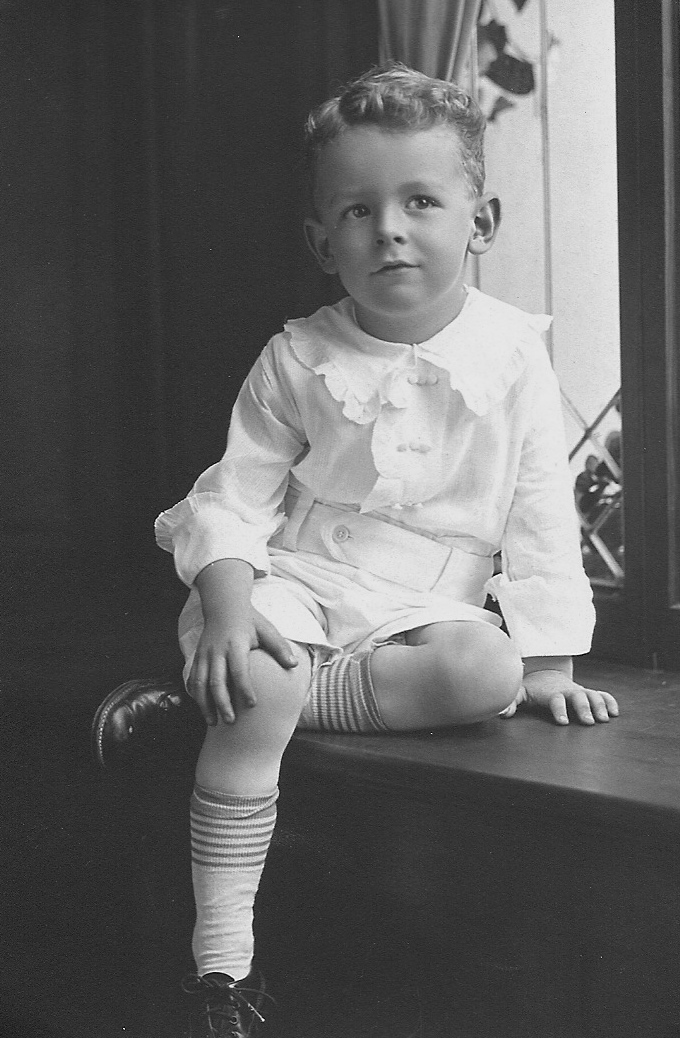
   Dad, a poised four-year-old with the first glimmerings of rebellion in 1920.   


Chapter I, Part 3


On our first full day as visitors in Neenah Dad took us out to see the carriage house, what the family called the barn - perhaps because its sole purpose had been to house horses and cows (and at one point a substantial flock of chickens), the carriages and sleighs having been kept elsewhere when not in use. Dad showed us the stables and tack room, where the oats were stored and the hay was kept, and the little fenced area behind the barn which was always referred to as the cow yard. In the process he inadvertently offered up a glimpse of some of the happiest, sun-filled memories of his boyhood. He never spoke about himself at home, but here in Wisconsin he showed us where he had nailed lath inside the abandoned hay chute to make a secret ladder up to the loft, and he talked about how in his teens he had surreptitiously scaled the tower of the house by rope, just to prove to himself that he could do it.

Dad also recalled a terrific electrical storm during one of his many extended visits. He was about twelve-years-old at the time and was up in the house with his mother in the boys' room, one of the bedrooms in back where his Uncle Harry and Uncle George had slept as children and which Dad was sharing then with his mother. The storm had come up as she was in the process of explaining the facts of life to him, and with a sudden clap of thunder a simultaneous bolt of lightening knocked the chimney off the barn. The electricity then powered down the barn's wiring to an inside faucet where the hired man was taking a drink. The electricity threw this poor fellow and his metal drinking cup across the stables, leaving him disoriented but unhurt, after which the electricity then jumped over to the horse stall where the window and porch screens were being stored, punching holes through all 117 of them.

"You don't forget a day like that" Dad said. This one comment was the closest he ever got to having the sex talk with any of his boys, a task he left to our mother. Had I known at the time I would have paid more attention.

Later that same morning we were scheduled to go down the street to visit Dad's Aunt Fan, the much beloved widow of his Uncle Harry. Not having had any children, Aunt Fan and Uncle Harry all but adopted several of their nieces and nephews, or at least so it seemed to the adoptees. In Dad's case Uncle Harry was his namesake and as such he stepped into his nephew's life as Dad's father traveled the country seeking diagnosis and treatment for the early onset of Alzheimer's disease, a nearly unknown disorder at the time that was swallowing him up whole. When Dad's father died in 1929 Uncle Harry's role in Dad's life grew even more significant, but then only briefly. A little more than a year later Harry died as well, unexpectedly, of a massive heart attack. After that there was no one else in Dad's life to take his place.


   The home of Harry and Fanny Babcock, as seen from the gardens, circa 1930.   


In our departure to see Aunt Fan (who had continued living in the sprawling house she and Harry had purchased in 1912) there was a good deal of murmuring and worried looks from Aunt Nell and Aunt Betty. In the car Dad explained that Aunt Fan was 82 and had not been well, and that the aunts thought she was unwise in attempting to entertain us. The facts were sufficiently gruesome to require an explanation and renewed warnings about our best behavior, accompanied by an admonition not to stare. Aunt Fan was not only confined to a wheelchair, but was required to wear a body brace, having bones so brittle that she had broken her back from simply trying to open a window, or so Dad said. She also had one leg that was grotesquely swollen, an edema that Dad diagnosed with astonishingly inaccurate medical authority.

“Elephantiasis,” he said. “She got it down south in Charleston.”

Given this introduction, it was hard not to stare when Aunt Fan finally came rolling into the front hall of her house - particularly since she made her entrance out of what at first appeared to be a closet but was in fact no less than a personal elevator. With all eyes on Aunt Fan, the body brace was clearly visible under her dress, and one leg was obviously more than twice the size of the other and very much like an elephant's. Seeing the look of horror on our faces, she tapped on the steel hidden by her dress and winked at my brother Steve. “Go on. Give me your best punch,” she said. “I’m tougher than Superman.” Mom alone was shocked by this, fearing I suppose that Steve might take Aunt Fan up on the challenge, but the joke put everyone else at ease. As old and as rich Aunt Fan as may have been, she had a keen understanding of people and human nature, which made it easy to see why she was so beloved.

For her share of our visit, Aunt Fan planned on taking us out to
North Shore Golf Club. Uncle Harry had been involved in the creation of North Shore just before his death, and it was one of several Aunt Fan still belonged to in spite of her physical condition. She had booked a private room there for our lunch and - we discovered - instead of set meal had arranged for us to order anything we wanted from a menu that very thoughtfully included hamburgers and hot dogs. Before that, however, she insisted on showing Mom what she had done with the house, having recently redecorated to the latest Architectural Digest standards in spite of her age and infirmity, simply because she could. The tour of impeccably furnished rooms drew very little interest from my brothers, but on the second floor, moving from bedroom to bedroom, none of which appeared to have ever been occupied, I saw Aunt Fan turn to Mom and gesture to the unused accommodations.

"This is where you would have stayed," she said, "had you ever been allowed."


CHAPTER I continues HERE

Saturday, January 5, 2013

The Misses Babcock


Miss Helen Babcock, seated, on her 80th birthday in 1953, with her sister Miss Elizabeth Babcock - my Great Aunt Nell and Great Aunt Betty. The simplicity of the photo nevertheless illustrates the complexity of their sisterly relationship, as seen in their expressions and body language.


CHAPTER I, Part 2

While we were out on the road on our cross country trip, Mom had read aloud to us from "Thunderbolt House" by Howard Pease, a Hardy Boys style mystery so captivating that vast stretches of each day passed with only the sound of Mom’s voice and the turning of pages. Through two complete readings back to back, plus a third on the return trip home, we listened to how the life of a small town California family in the early 1900s was transformed by the inheritance of a San Francisco mansion, how each member of the family was brought down by the their ascent into Nob Hill society, and how the only thing that saved them was the earthquake and fire that destroyed the city in 1906.

And so now here we were in Wisconsin, the book freshly closed and set aside, walking up to the door of a mansion as every bit a mystery as the one on the cover.

Ushered inside by a uniformed maid, we passed through heavily upholstered rooms with high gilded ceilings and brocaded walls into the presence of my father’s Aunt Nell and Aunt Betty, or - as they were locally known with grammatically archaic formality - the Misses Babcock. Tiny and stone deaf at 88, Aunt Nell was the first born, oldest living, and long established matriarch of the family. She had ridden a camel in Egypt, taken to the skies as a passenger in one of the first flying machines, and unlike most of her contemporaries had committed much of her life to helping those in need, and to giving unstintingly to all manner of community projects that a town the size of Neenah would not otherwise expect to enjoy. In sharp contrast, her taller but diffident sister Betty was the 79-year-old baby of the family who had spent most of her life under her sister's wing, supporting Nell's good works and taking care of the home.

Neither lady was more than dimly familiar to me as an eight-year-old, but their presence in our lives was far from remote or shadowy. At our great distance away in California we had been showered each year with a formidable array of Christmas gifts, and as each of us turned twelve these Wisconsin ladies marked our transitions into adulthood by substituting presents with an annual check made out for a manly $25, a sum so substantial and impressive at the time (Mom and Dad were given a joint $75) that opening a savings account followed without protest.

Every two or three years the aunts would also come out to San Francisco, at which point we would all be washed and dressed and taken into the city and briefly put on display for them at places like the
Mark Hopkins or the Fairmont or the Clift Hotel, institutions of such luxury and privilege that the visits were more like stereopticon views of foreign lands, vaguely distorted and so removed from our own time and way of life that they were easily set aside or forgotten, except as some passing curiosity. It never really occurred to those of us on display that the lives of these ladies were in any way umbilically connected to ours.

Occasionally the two of them might alternately come to our house as part of some larger family gathering, for which Mom would dedicate months to properly stage, first cleaning and reorganizing every corner and cupboard of the house, then preparing an elaborate meal inevitably using the entire Royal Doulton china service Aunt Nell and Aunt Betty had picked out with her at
Gump’s of San Francisco, their present to Mom when she married Dad. And when finally welcomed into our home with all the solemnity of visiting heads of state, the two sisters would very kindly comment on how perfectly everything had been arranged, and Aunt Betty in particular would remark on the dinner, noting that she was unable to get their cook to fix more than one vegetable and here Mom had prepared three.


My father, Henry Babcock Adams, walking my oldest brother Bob along the Neenah shoreline during their visit in 1941.  The tension that existed between them all their lives was clearly evident even then.


Mom, however, was certain that both Aunt Nell and Aunt Betty disapproved of her, recounting repeatedly as evidence the events of her first and only other trip to Wisconsin, which had taken place in 1941 when my oldest brother Bob - newly married at the time of our trip - was a rambunctious two-year-old. At lunch on the first day of that earlier visit Mom had taken Bob out of the ornate Victorian high chair that had been set up for his use and let him run around the dinner table as the adults continued to talk. She then took him upstairs to change his diaper and to her horror discovered that while the diaper had been soiled, it’s contents had escaped to parts unknown.

How the errant turd escaped from both the diaper and Bob's clothing remains a mystery, but during her ensuing search of the intricate patterns of oriental carpets and parquet flooring, Mom was approached by Aunt Betty who readily offered to help, assuming the hunt was for nothing more offensive than a missing earring. When apprised of the real objective, Aunt Betty turned white, then quickly mustered all available hands into a bucket brigade outfitted with mops, pans, cleaning fluids and flashlights. Eventually the wayward excreta was found on the dining room carpet, remarkably untrammeled given the number of parties involved in its recovery. And shortly thereafter, to Mom’s everlasting chagrin, a nurse was hired to take charge of Bob for the remainder of their visit so that Mom could relax more during her stay. From this Mom inferred that she had been cast as nothing less than an unfit mother.

Now some twenty years later there were four children in tow, all seated in that very same dining room around a table set with linen, china, crystal and sterling, being served fried chicken by a procession of maids in white organdy aprons, each carrying some part of the meal on silver platter perched upon little white cushions trimmed in tatted lace. Sitting next to Mom, I mumbled something about wanting ketchup and was shushed with a little more emphasis than I had normally come to expect. Moments later, however, a tiny silver pitcher of the stuff was set at my place, summonsed through the oracle of Aunt Betty’s attentive ear and a buzzer to the kitchen hidden under the carpet.

And while it seemed to me in the moment that nothing could have been more amazing than that little pitcher of ketchup, when the dinner dishes were removed each place was next set with a finger bowl of warm scented water, for any of us who might have used our fingers to pick up a chicken wing or leg. This fastidiously thoughtful interlude, preceding the apple pie and cheese, was no less astonishing and exotic to me than had a band of whirling Dervishes come spinning around the table.

I had never seen anything like it before - and never would again.


CHAPTER I continues HERE

Sunday, December 30, 2012

The Journey Begins


The Havilah Babcock House circa 1908, Neenah, Wisconsin.


CHAPTER I, Part 1


In 1962 when I was eight years old, my family set out on a cross country road trip from our home north of San Francisco to the East Coast and back. Mom, Dad, me, three older brothers and a yellow Pontiac station wagon. Bill, a sophomore in college, sat up in front and took turns driving with Dad, while Dave and Steve, both in their teens, divvied up the window seats in back with Mom. As the smallest and least significant, I rode behind everyone else with the luggage, where the only unobstructed view was out the rear hatch. From this position in the family hierarchy I seldom had any idea where we were going but always had plenty of time to think about where we had been and what we were leaving behind.

Dad’s original idea in taking this trip was for us to see the country, only once we were out on the road making good time became more important than having one. “We can always see that kind of thing on the way back,” he said about Yellowstone and the Badlands, both of which had been vaguely promised but were no where near the route we were on. Driving each day until the dead of night, we stopped only at greasy cafés and dusty gas stations until finally, pushed to the brink of exhaustion, Dad would turn in at some dimly lit roadside motel where the neon vacancy sign flickered ominously. As he walked over to the office to register, Mom would call out, “Make sure it’s clean.” Minutes later, following what could only have been a cursory inspection of the premises, Dad would return to make his report.

“Well,” he’d say, “it’s not flossy."

While the best of these places smelled of moth balls and disinfectant, and had white chenille bedspreads and sanitary paper tapes across the toilet seats, the majority were part of what must have been a vast Bates Motel franchise, complete with worn-out linoleum rugs, rusty bathroom fixtures and bare exposed light bulbs dangling from the ceilings. No TV, no pool, no air conditioning, no nothing. Except once there was an oil derrick that groaned all night outside the only window that opened. That was the motel where there weren't enough rollaways for all of us and Dave volunteered to sleep in the bath tub because Dad didn't want to pay for two rooms.

Years later I learned that a road trip like ours had been one of the few happy memories Dad had growing up. His was in 1931 when he was fifteen years old, two years after his father had died of Alzheimer’s disease, the same year his mother had been diagnosed with inoperable cancer. His mother had promised that when his older sister Mary graduated from high school the three of them would go to Europe, only when the time came it was the middle of the Depression, and his mother felt such an extravagance would be in very poor taste. So instead she bought a touring car, hired a driver and took them all on a three-month circumnavigation of the continental United States, revisiting all the places that had been important in her life.


The bird bath in Aunt Nell's formal gardens, being fished by Dad's Louisville cousins George, Harry and Blandina Babcock, circa 1935.


Like us they started out from California, only the first part was by train, arranging for the driver to follow along in the car and meet them in Chicago after they had spent a week or so with Dad’s aunts in Wisconsin. For Dad this first stop was the high point of the entire three months. His aunts had no children and the three of them were devoted to their nieces and nephews, making Wisconsin the only place Dad ever thought of as home - not his mother's house in the foothills of Berkeley, nor any place he ever lived with us for that matter. Even as an adult Dad visited these aunts every chance he got, taking side trips to Wisconsin whenever he passed through Chicago. Our own trip was no exception.

I don’t remember driving up into Wisconsin out of Illinois or continuing north from Milwaukee to Neenah, but what does come back clearly begins on the edge of town, where Dad pulled into a drive-in on Main Street, bought us all milkshakes and announced that for the next three days we were to be on our best behavior. No discussion, no debate, and no threatened consequences because there was no alternative to full compliance with whatever Dad expected of us. His fury, when unleashed, could be volcanic. Only Dave, with whom Dad never uttered a harsh word and therefore enjoyed certain liberties the rest did not, ventured to voice his opinion.

“Looks like we're spending the weekend in church.”

From the drive-in we continued on into town over railroad tracks, past old mills, and through a handful of commercial blocks that made up a rather ordinary Midwestern downtown, emerging finally at the other end on a wide, elm-shaded avenue of houses that quite suddenly became spectacularly grand and impressive. The street then came up along side a little marina of boats formed out of a bend in a river, and there, without fanfare or warning, Dad turned in at one of the largest and most impressive of the houses - a brick Victorian mansion that looked something like a Tudor castle, complete with an imposing tower, sprawling stone verandah, formal gardens and a carriage house that was bigger than our home in California.

This, it was safe to say, was flossy.


CHAPTER I continues HERE