
 |
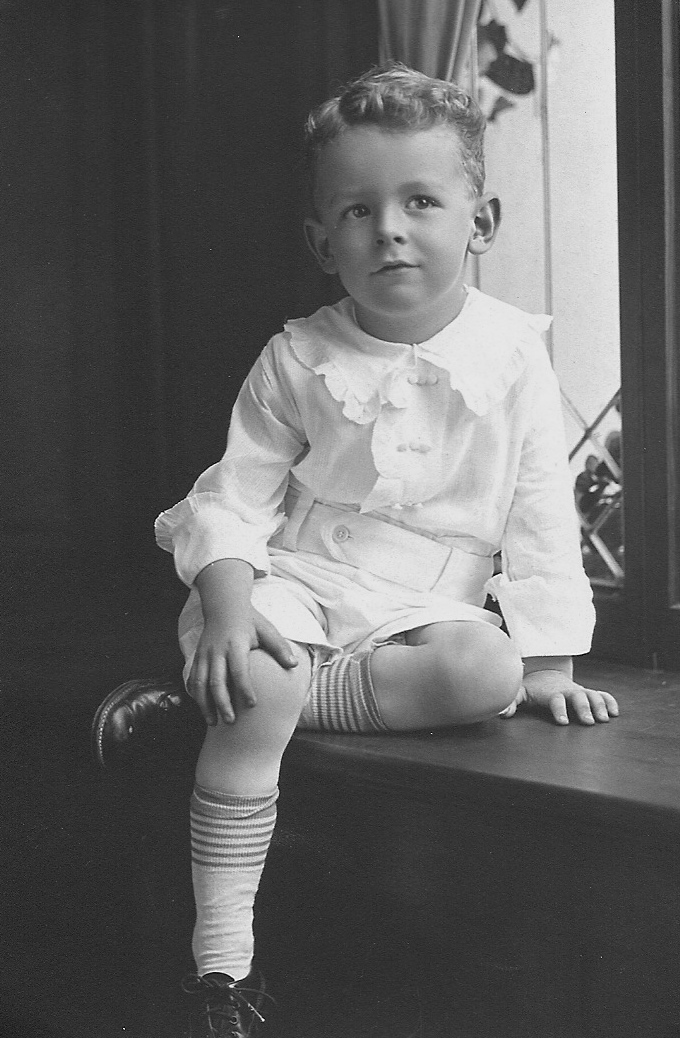
Dad, a poised four-year-old with the first glimmerings of rebellion in 1920. |
Chapter I, Part 3
On our first full day as visitors in Neenah Dad took us out to see the carriage house, what the family called the barn - perhaps because its sole purpose had been to house horses and cows (and at one point a substantial flock of chickens), the carriages and sleighs having been kept elsewhere when not in use. Dad showed us the stables and tack room, where the oats were stored and the hay was kept, and the little fenced area behind the barn which was always referred to as the cow yard. In the process he inadvertently offered up a glimpse of some of the happiest, sun-filled memories of his boyhood. He never spoke about himself at home, but here in Wisconsin he showed us where he had nailed lath inside the abandoned hay chute to make a secret ladder up to the loft, and he talked about how in his teens he had surreptitiously scaled the tower of the house by rope, just to prove to himself that he could do it.
Dad also recalled a terrific electrical storm during one of his many extended visits. He was about twelve-years-old at the time and was up in the house with his mother in the boys' room, one of the bedrooms in back where his Uncle Harry and Uncle George had slept as children and which Dad was sharing then with his mother. The storm had come up as she was in the process of explaining the facts of life to him, and with a sudden clap of thunder a simultaneous bolt of lightening knocked the chimney off the barn. The electricity then powered down the barn's wiring to an inside faucet where the hired man was taking a drink. The electricity threw this poor fellow and his metal drinking cup across the stables, leaving him disoriented but unhurt, after which the electricity then jumped over to the horse stall where the window and porch screens were being stored, punching holes through all 117 of them.
"You don't forget a day like that" Dad said. This one comment was the closest he ever got to having the sex talk with any of his boys, a task he left to our mother. Had I known at the time I would have paid more attention.
Later that same morning we were scheduled to go down the street to visit Dad's Aunt Fan, the much beloved widow of his Uncle Harry. Not having had any children, Aunt Fan and Uncle Harry all but adopted several of their nieces and nephews, or at least so it seemed to the adoptees. In Dad's case Uncle Harry was his namesake and as such he stepped into his nephew's life as Dad's father traveled the country seeking diagnosis and treatment for the early onset of Alzheimer's disease, a nearly unknown disorder at the time that was swallowing him up whole. When Dad's father died in 1929 Uncle Harry's role in Dad's life grew even more significant, but then only briefly. A little more than a year later Harry died as well, unexpectedly, of a massive heart attack. After that there was no one else in Dad's life to take his place.
 |
The home of Harry and Fanny Babcock, as seen from the gardens, circa 1930. |
In our departure to see Aunt Fan (who had continued living in the sprawling house she and Harry had purchased in 1912) there was a good deal of murmuring and worried looks from Aunt Nell and Aunt Betty. In the car Dad explained that Aunt Fan was 82 and had not been well, and that the aunts thought she was unwise in attempting to entertain us. The facts were sufficiently gruesome to require an explanation and renewed warnings about our best behavior, accompanied by an admonition not to stare. Aunt Fan was not only confined to a wheelchair, but was required to wear a body brace, having bones so brittle that she had broken her back from simply trying to open a window, or so Dad said. She also had one leg that was grotesquely swollen, an edema that Dad diagnosed with astonishingly inaccurate medical authority.
“Elephantiasis,” he said. “She got it down south in Charleston.”
Given this introduction, it was hard not to stare when Aunt Fan finally came rolling into the front hall of her house - particularly since she made her entrance out of what at first appeared to be a closet but was in fact no less than a personal elevator. With all eyes on Aunt Fan, the body brace was clearly visible under her dress, and one leg was obviously more than twice the size of the other and very much like an elephant's. Seeing the look of horror on our faces, she tapped on the steel hidden by her dress and winked at my brother Steve. “Go on. Give me your best punch,” she said. “I’m tougher than Superman.” Mom alone was shocked by this, fearing I suppose that Steve might take Aunt Fan up on the challenge, but the joke put everyone else at ease. As old and as rich Aunt Fan as may have been, she had a keen understanding of people and human nature, which made it easy to see why she was so beloved.
For her share of our visit, Aunt Fan planned on taking us out to North Shore Golf Club. Uncle Harry had been involved in the creation of North Shore just before his death, and it was one of several Aunt Fan still belonged to in spite of her physical condition. She had booked a private room there for our lunch and - we discovered - instead of set meal had arranged for us to order anything we wanted from a menu that very thoughtfully included hamburgers and hot dogs. Before that, however, she insisted on showing Mom what she had done with the house, having recently redecorated to the latest Architectural Digest standards in spite of her age and infirmity, simply because she could. The tour of impeccably furnished rooms drew very little interest from my brothers, but on the second floor, moving from bedroom to bedroom, none of which appeared to have ever been occupied, I saw Aunt Fan turn to Mom and gesture to the unused accommodations.
"This is where you would have stayed," she said, "had you ever been allowed."
CHAPTER I continues HERE


