These posts are presented as a serialization that is best appreciated by starting with the first post HERE. You can then proceed in order by clicking on the HERE links shown in red at the bottom of every post.

If you enjoy these stories, please consider subscribing by email, or joining as a follower, both available in the right hand column below. You can also help spread the word by sharing a link with others.

Click HERE to see what the Wisconsin Historical Society has to say about “An American Downton Abbey.” You can also read about our inclusion in the society's 2010 publication, "Wisconsin's Own: Twenty Remarkable Homes," by clicking on the book's cover on the right below.

Jen Zettel's story for Gannett Wisconsin Newspapers generated a huge increase in page views! See what she wrote and follow the links to view clips of the interview HERE.

MORE MANSION, MILLIONAIRE AND GOOD LIFE PHOTOS TO BE ADDED SHORTLY.
Showing posts with label SFTS. Show all posts

Sunday, April 14, 2013

Little Pitchers Have Big Ears


When Great Uncle Alvin died in 1958, Grandma went to comfort her sister and essentially never came back to live with us. Although still financially dependant, the happiest period of her life was probably the six years spent at 355 Corralitos Road, which is evident from her expression in this photo from a Christmas card I'm certain Great Aunt Jessie had printed for Grandma to send out. The romance of Uncle Alvin's life permeated the house and allowed us a tangible glimpse of his Polynesian expeditions as recorded in "Quest For the Golden Cloak," which Grandma as a former school teacher helped to edit. I was horrified and dismayed when Grandma and Aunt Jessie moved in 1964 to a retirement home, the ranch sold and the contents of Uncle Alvin's study dispersed to the Bishop Museum, the Steinhart Aquarium and Stanford University, his alma mater. I'm sure this house was the origin of my fascination with the lives of other people as reflected in their homes, that and the conviction that some houses must be kept together and lived in as continuing reminders of the kind of people we once were and should strive to emulate. While still standing, Uncle Alvin's meticulously maintained ranch house and grounds are today grotesquely overgrown and fallen sadly into a shamefully negligent state decay, as seen in the above Google map link. His apple orchard also appears to have been replaced by vineyards.


NOTE: The posts in Chapter II follow the events leading up to my father's return to Neenah as I saw them. If you are just beginning to read this blog you may want to go back and start with the first post HERE. For those of you who are reading because they love stories about Neenah, I'm certain you'll find this chapter engaging and an important part of a moving human drama that has everything to do with Neenah, its history and the six degrees of separation that link link us all together.

CHAPTER II, Part 6

As much as it may have seemed that Dad's career and our life on the seminary were settled and on track, both in fact were coming apart as quickly as they came together. The first clue came in 1958, just two years after moving onto campus, when Grandma got word that Great Uncle Alvin had died. In short order Grandma packed her bags and went down to Corralitos, where she planned to comfort her now widowed younger sister Jessie. Twelve years her senior, Grandma had essentially raised Jessie, which made Grandma's coming to the rescue a familiar and comforting reminiscence for both women. Very quickly, however, these sisterly roles were reversed, with the grieving Jessie inviting her penniless older sister to come live with her and enjoy the kind of life Grandma had lost forty years earlier in the depression. It was probably one of the easiest decisions she had to make.

Aunt Jessie was well off and ensconced in a handsomely appointed mission style ranch house supported by the profitable apple orchard Uncle Alvin had developed around it.  As a boy I remember there being glass cabinets full of delicate china and memorabilia of world travels, as well as the implicit sound of drums and native voices coming out of Uncle Alvin's untouched study, which was chock-a-block with exotic atlases, aboriginal spears, shrunken heads and an equally frightening assortment of grotesque mounted fish. Outside there were also the rose gardens, fish ponds and fountains Uncle Alvin had tucked into nearly every corner of the manicured grounds around the house, in spring the air scented by apple blossoms and in fall by the musky odor of ripe fruit. More important from Grandma's perspective was the bedroom Aunt Jessie had indulgently decorated for her in pink, swathed in ruffles and satin, and outfitted with the kind of dressing table a lady needed to always look her best - all for Grandma and the farthest thing possible from her days living in a sod house on the prairie, let alone living with us.

One would think Grandma would have been deliriously happy, but the return of comfort and security loosened her snarky tongue even further than before, opening a floodgate of criticism and sniping aimed entirely at Mom. Well, almost entirely. On her first return visit to Bolinas Avenue, I waited at the bottom of the stairs for Grandma to come down for breakfast, and when she did all she said to me was, "My, what a fat little face you have." (Overhearing this, Mom later said she wanted to slap Grandma for the hurt she caused me, but I now think it was more the hurt the remark caused her.)  On yet another occasion Grandma called Mom and detailed the royal treatment she had gotten while visiting Angela, Mom's older sister, concluding her account with, "You never did anything for me." Absurd on the face of it alone (my parents had been Grandma's sole financial support for nearly 20 years), Mom nevertheless proceeded to write down a detailed indictment of Grandma's crimes against her, which she then inexplicably read to me, and which instead of sending to Grandma or destroying, Mom kept securely with her for years (and may still be tucked away somewhere among her papers in the attic).


Cooking in our house established Mom as the daily center of attention, even in the Bolinas Avenue kitchen where she shared counter space with Bob's aquariums of exotic fish (with the squirming brine to feed some of them being refrigerated in one of her Pyrex casseroles). At breakfast there was always a crowd of family and sometimes company sitting around that little table while she fixed pancakes or French toast or "meat eggs," her own fulsome mixture of ground beef and scrambled eggs. Cooking was also the  principal antidote Mom had at her disposal for treating any problem that entered her sphere of influence. Her repertoire of palliative care included such hearty fare as Texas hash, tagliarini, enchilada pie, chop suey, meatloaf (with twice baked potatoes), and literally cauldrons of spaghetti, the pasta and sauce tossed together and cooked on the stove top until  deliciously though unauthentically caramelized. Branching out as we grew older, she trolled magazines and newspapers and the kitchens of friends, always in search of that new and enticing dish that would draw praise and generate contented healing. That was for Mom the holy grail of cooking, fuflilled only when the was table set and decorated for some gathering, the kitchen redolent of enticing deliciousness. It was also a way of distinguishing herself from Grandma, whose repertoire was pretty much limited to such haute cuisine as beans on toast, boiled dinner and creamed chipped beef.


In all fairness to Grandma, her departure was undoubtedly hastened by living under the same roof with a household comprised almost entirely of teenage boys, whose relationships with their father - and therefore each other - were at the very least complicated. On the top of the pile was Bob (by this point a student at the University of California - Berkeley), whose intensity when mixed with Dad's turned minor differences into open warfare, most often with one or the other opening fire over some trivial provocation at dinner time.  Mom, never a calming influence or one to handle discord with any personal detachment, took Bob aside one day and made him write out three checks to her for $100 each, nearly emptying his account, explaining that from then on every time he started a fight with Dad she was going to cash one check. When the last one was spent, Bob would be kicked out. She then sat Dad down, had him write out three checks for $1,000 each, and gave him the same ultimatum, three fights and he'd be sent packing. With Dad she adding her personal guarantee that each $1,000 would be spent frivolusly, a threat aimed directly at Dad's was most vulnerable body part - his wallet. From that day forward, continuing well into their later years, Bob and Dad remained guarded when together in Mom's company, wary of any renewal of these threats - or perhaps fearful that the checks were extant and still valid.

In Bob's defense, not all the conflicts at home involved him. For although they found a near legendary companionship in their mutual enjoyment of the out of doors, Dad's relationships with Bill and Dave were complicated by an intense rivalry for Dad's attention and approval. When least expected the underlying jealousies would erupt in retaliatory strikes - like the time Bill took the vacuum cleaner outside and blew unripe plums through Dave's open bedroom windows, staining the wallpaper and smashing the model airplanes Dave had made and carefully hung from the ceiling. Frequently caught in the line of fire, my brother Steve implemented his own military strategy of full disengagement, remaining hopeful that another family would eventually take him in. 
Even as a child he seemed to be on the look out for an opening, on one occasion disappearing at the beach, where after a frantic search he was found sitting happily with strangers. When asked by Mom why he had run off, Steve replied very simply, "They have a better umbrella." A more promising opportunity came later in the form of our Uncle Gene Reiner, who was married to Dad's sister Mary, was the father of four girls, and had long wished for a son. After a week of male bonding at their home in Santa Maria, Steve returned to San Anselmo disillusioned.  A houseful of girls, it turned out, could be just as contentious as a houseful of boys


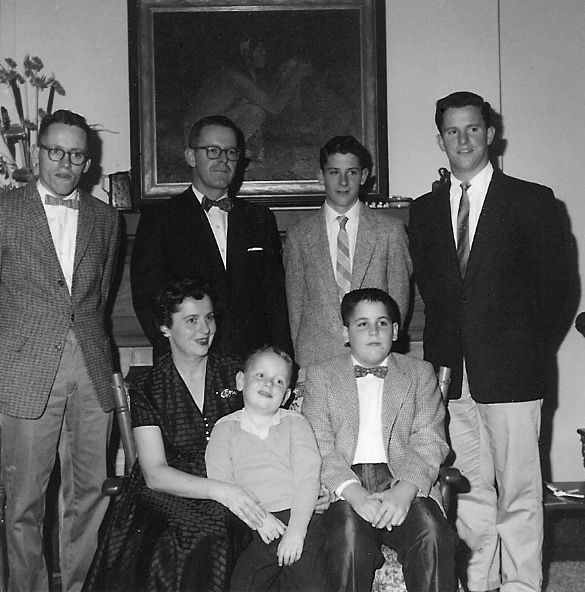
During his visit to Neenah in 1960, Dad asked about the painting he fondly remembered as a boy hanging over the fireplace in Uncle Harry's library on Wisconsin Avenue. Learning of his interest in it, Aunt Fan got it down out of the attic and sent it to us.  When Dad hung it over to the fireplace in our living room my brothers were shocked. "You aren't going to put that naked man up there, are you?" Dave asked. That fall Bob announced his  plans to marry Marilyn Patterson, his high school sweetheart, and to mark this turning point Dad arranged for a photographer to take a family picture of us all in front of the painting which was his link to the one man who was like a father to him. The body language and expressions this picture records speaks volumes. From the left, standing, are Bob (21), Dad (44), Dave (15) and Bill  (18). Seated in front are Mom (44), me (6) and Steve (11). As for the painting, it was created in 1913 and entitled "Beaded Bag," one of a series by western artist E. Irving Couse. Dad loved this painting for it associations, and it followed us back to Neenah where eventually Dad sold it in 1983 to help fund the preservation of his grandfather's house - which Dad loved even more. All the same, it is an odd sensation for me to see prints of a painting I grew up with - and admired for its use of light, rich colors and composition - being marketed by art shops on line.


As for myself, I flew under everyone else's radar, for as a whole my family had no concept of the old adage, "Little pitchers have big ears."  I heard and observed a great many things that were wrongly assumed to be beyond my understanding, as is the case with most children. I had, for example, a very clear picture of the increasing number of professional problems that were confronting Dad. From what I now know these began not long after Grandma moved out, when Mom and Dad attended an evening faculty gathering to introduce the seminary's new president, Theodore Gill, the successor to Dad's long time mentor, Jesse Baird.  Returning home much earlier than expected, they were both dumbstruck by the radical changes the occasion foretold. Instead of the Presbyterian staples of tea or coffee, cocktails were served while the 38-year-old guest of honor worked the room wearing joke glasses with bulging eyeballs dangling on springs, providing a dubious faculty with numerous examples of his off-color sense of humor.  As was even recorded years later in a privately published seminary history, when asked on this occasion who had influenced him to enter the ministry, Gill told those assembled, "God, I hope! God or gonads, I've never been sure which. Actually, I've heard that the church was a dying institution and I wanted to be in on the kill."

This was only the beginning. 

Up until to that point alcohol and tobacco had been more or less prohibited on campus, at one point to the extent that the discovery of a beer can in the seminary incinerator resulted in a formal campus investigation into the matter. Now all that and more was being swept away. During our summer pot lucks on the back porch, Mom and Dad freely discussed the state of the seminary with the Duncans, who had their own horror stories to report. On one of these occasions Stu recounted the number of men found spending the night - and using the showers - in Susanna Baird Hall, the women's dormitory, adding how the maintenance crew would not work at the house of one of the new professors if his wife was home, given how whatever the time of day, the bathrobe she invariably appeared in always fell open in their presence. To this  Mom noted that the milkman took a half hour between that house and ours, with Dad adding that the professor in question was having an ongoing affair with his secretary. On yet another evening Dad also passed along how the new president, the married father of two, only traveled first class and with a young male secretary who had limited typing skills. How factual these and other statements were I can't assess beyond that my parents and the Duncans believed every word to be true. What I do know is that at one point I was able to secretly climb up inside the bell tower of Montgomery Hall (where the faculty offices were located) and there on the roof I found a mattress, chair, some clothing, and half a dozen empty bottles. Whoever it was who brought them up there I never found out. I can only say is that it would have taken significant determination to get a mattress of that size up the hill unnoticed, let alone up the twisting spiral staircase.

And yet while seminary morale was rapidly deteriorating, in 1961 Dad was offered a great opportunity - to be the director of the newly organized office of Advanced Pastoral Studies, a doctorate program for ministers wanting to earn an advanced degree and improve their professional standing on a part time basis. Dad knew the position had been presented to him because none of the new order of academics wanted to risk their professional reputations on anything that they thought certain to fail - but their disinterest was challenge enough for Dad to accept. So like with the broadcasting program he had spearheaded nearly a decade before, Dad was soon developing the course of study, rounding up his teaching staff, and promoting this great new educational innovation at gatherings of church leaders and clergy around the country. Our own driving trip back to Neenah in 1962 was part of one such circuit, with stops in Toronto, New York and Virginia. And while Bob was by then married and living down in Los Angeles (and Bill and Dave wanting no part of being cooped up with the rest of us for any period of time), the four weeks on the road passed without mishap or melt down and produced many fond memories of the places we saw together as a family. For Dad it also opened his eyes to what it was to be relaxed, to realize that life did not have to be the constant battle it had become, and to the discovery that in spite of all the complications and conflicts, his children were in fact good company - all this just at the point when we were beginning to leave the nest and the family itself was coming undone. 

And that, I suspect, must have been when the light bulb first went off in his head.


CHAPTER II continues HERE.


Tuesday, April 2, 2013

Hints of Drama and Back Story


This is me at about age five, sitting on the living room coffee table at Bolinas Avenue, trying my best to assemble a Sunday School collection box shaped like a church. This picture, while slightly out of focus, has very fond memories for me, largely because Dad had me pose for it, and for those few brief moments I was the center of his attention. Dad never had any time for - or if the truth be told, interest in - teaching me how to ride a bike or playing catch or reading stories to me. If  you wanted to be with Dad it was always on his terms, doing what he wanted to do, which was the lesson Bill and Dave learned and came to embrace early on. By the time I was old enough to be included on camping trips, Dad and my brothers had progressed to more physically demanding pack trips deep into the Sierra Nevada Mountains, on which I came to understand that I would have been an encumbrance rather than a welcome addition. As a result I developed no interest in hunting or fishing - or for that matter the discomforts of camping - making any time with Dad at this point in my life severely limited.


NOTE: The posts in Chapter II follow the events leading up to my father's return to Neenah as I saw them. If you are just beginning to read this blog you may want to go back and start with the first post HERE. For those of you who are reading because they love stories about Neenah, I'm certain you'll find this chapter engaging and an important part of a moving human drama that has everything to do with Neenah, its history and the six degrees of separation that link link us all together.

CHAPTER II, Part 5

It truly is an ill wind that doesn't blow some good, and such was the case with our life on the seminary, at least from my perspective. While Dad was to become an even more shadowy presence at home - and then more irritable than before - having more than twice the house than on Brookside Drive allowed everyone to retire to their own corner before coming to blows. Fights between my brothers became non-existent on Bolinas Avenue, or at very least less direct, more subtle and non-physical. And while having her mother directly under foot was a decided source of tension for Mom, Grandma had announced that in moving in with us she would be taking over my care, allowing Mom to give more attention to everyone else, especially Steve, who as the former youngest I had abruptly preempted as the center of Mom's attention.

My grandmother lived with us for only two years, but looking back I can now see how she was instrumental in shaping my character, mostly for the better. In setting up her new room on Bolinas Avenue, she picked out furniture that was just the right height for a three-year-old to climb into and sit beside her when it came time for stories, always some kind of an adventure with an underlying moral or life lesson, like "Robot the Rabbit" and later "Bowser the Hound," perennial favorites in our household. Grandma also bought bags of colored plastic cars and little figurines which I remember she would have me sort by color, size or any other characteristic she could come up with, and in place of that we also stuck colored straight pins in her tomato pin cushion to make stars and pinwheels and other patterns, all of which encouraged me to be observant, to see patterns and order, to have an appreciation of differences and similarities, and to notice the kind of details that I found with time most others ignored. If not her best student, I was undoubtedly one of her most devoted and at the very least certainly her last.

And while there were no other children on campus of any age when we first arrived, the gradual increase of new professors and administrators generated an influx of young families which produced a small group of neighborhood kids for me to play with. The experience was similar to what my brothers had on Brookside Drive, the primary difference being that while the youngest at home - where I counted for very little - out on the main drive up Seminary Hill where the campus kids congregated, I was the oldest, an elder statesman, or at the very least the cruise director, organizing games and activities that everyone, whatever their age, could participate in. For as much as our parents were seldom found in the same room together except as compelled, the seminary children were frequently together every day, an isolated group of youngsters largely removed from the rest of the town, a fate which required us to get along and make the most of and value each other's company - even if the adults found each other repellent. 


In addition to her friendship with Betty Duncan, Mom found real pleasure in putting her sewing skills to use as costume mistress for the Festival Theatre, a professional acting troupe that took up residence in the seminary's abandoned gymnasium in 1960. In this  publicity photo for Thornton Wilder's "The Skin of our Teeth," one of the company's earliest productions, Mom is in her element, the center of attention, her handiwork being admired and confirmed by other women, and my brother Steve near at hand. Modeling their costumes as the pet dinosaur and mastodon that appear in the first act are cast members Greg Duncan and Steve, with Mom, Betty Come (another professor's wife who was included in the photo to demonstrate faculty support of the production), and Betty Duncan, who shared costuming duties with Mom. Both Steve and Greg would at various times later serve as technical managers at the Festival Theatre.


Early on, however, it was not quite so rosy. There was the professor's son, for example, who threatened me with a knife and made me drop my pants, as well as the administrator's three daughters who took off my clothes and played doctor with me while our mothers were having tea downstairs (these same girls later threw rocks at me, I suspect in retribution for whatever punishment they may have received for praying upon my compliant nature).  While these two families moved off campus shortly thereafter, both incidents took place in the house later occupied by the Lees, whose children were much younger than I but nevertheless became like a second family to me. A fourth generation Chinese American, their father Bob Lee set a tone of professorial lèse-majesté around the house by singing the barroom version of Bizet's "Toreador's Song," complete with references to cuspidors and their purpose, while their mother May Lee made intoxicatingly delicious Chinese wedding cookies and could whip up the best potato salad ever at a moment's notice. The Lees also had a boarder named Margot, a nursing student from Sacramento whose parents were Christian Scientists. She drove a baby blue Volkswagen Beetle and could do no wrong in my eyes.

For my brothers the transition to Bolinas Avenue was more difficult, being removed from their established circle of friends, and in that were not as fortunate as I. Mom and Dad, however, found good friends in Stuart and Betty Duncan, who lived just off campus across the street. Stu, the son of a seminary professor, had returned to San Anselmo after service in World War II and joined the seminary's maintenance staff, eventually becoming chief superintendent. In Stu Dad found a replacement for Walt on pack trips, one who had a first hand understanding Dad's work, but from an entirely different and therefore illuminating perspective. In Betty Mom similarly enjoyed the leavening companionship of a woman who shared many of the same skills and interests as Mom, but who never seemed to let any of them take over her life or impose themselves upon Betty's calm enjoyment of simply sitting out on her back porch on a sunny day with a cup of coffee and a crossword puzzle, the dirty dishes and laundry left to take care of themselves.

Included in the Duncan package were their two children, Greg and Linda, who were approximately the same ages as Steve and I, and which in conjunction with the friendship of our parents established all of us as intimates in our mutually extended families. During these years Linda and I in particular were inseparable in a very compartmentalized sense. For while on most afternoons the Lees and I would organize games of "Sardines," "Colored Eggs," and "Mother May I," Linda and I would periodically spend days together at our house, sometimes for as long as three weeks non-stop, developing elaborate plot lines and characters, and building little sets of houses and villages out of blocks, American Bricks and a commingling of pieces from my diverse Marx Brothers play sets (of everything from "Fort Ticonderoga" to "Ben Hur"), all for acting out stories revolving around what are now collectible animal-shaped erasers, an activity we simply referred to as "playing rubber animals." 


Christmas dinner was a much smaller affair in comparison to our Thanksgiving blow-outs, but even here at this point in her life Mom unfailingly put on the dog with candles, centerpiece, china, silver and crystal goblets. In this picture (not one of Dad's better compositions) the napkins have felt poinsettia napkin rings that Mom made and we still have. From the left are Dave, Bill, Mom, me, Steve, Bob (obscured) and Dad - who in spite of all the fuss (or perhaps because of it) came to the table in flannel shirts, or in Steve's case his tee shirt. While my brothers look put upon, I am clearly impressed by the domestic pageantry. Note the priscilla curtains are still fresh and gleaming from their fall cleaning.


With or without rubber animals, the Duncans were regular fixtures at our house - and vice verse - particularly in warm summer months for pot luck suppers and picnics outdoors, a comfortable and leisurely routine I don't recall being repeated inside at either house when the weather turned colder. School, of course, intervened, as did the seminary's academic year, during which Mom's focus turned to maintaining the traditional home gatherings for Dad's students - something the other new professor's wives seldom if ever undertook. Mom also gave much of her attention to the Thanksgiving extravaganzas that over Dad's protests she would annually orchestrate for every living relative within a day's drive of San Anselmo. Always up for a party and a houseful of people as hostess (and less so as guest), Mom had suppressed the full expression of this convivial part of her nature until moving to Bolinas Avenue, where she at last had the space and the rationale for assuming the cloak of society hostess Pearl Mesta

In that period of our lives dinner was the fundamental ritual at our house, one which took on banquet proportions on holidays with relatives. For months in advance Mom would approach the arrival of both Dad's Adamses and her Luthers with as many stratagems as Eisenhower's invasion of Normandy. Cookbooks and home magazines were always key to her planing effort, but first and foremost was the cleaning of the house with an attention to detail that bordered on the obsessive compulsive. Mom categorized this level of cleaning as "knock down, drag out" and it had as it's main thrust the cleaning of the muslin priscilla curtains she had made and that hung on every window, and which in a year's time would become limp, dusty and fly specked.  Removed with the utmost care, they were treated for stains and repaired as needed, and then washed, starched (using liquid, not spray starch) and ironed - every ruffle and flounce of them - to a razor sharp and gleaming crispness that spoke to a dazzling standard of cleanliness, which in the final analysis was certainly exhausting if not always entirely exhaustive. 


At Thanksgiving, when there invariably was company, Mom always out did herself. Here the table is set with the water goblets Aunt Nell and Aunt Betty gave Mom as wedding presents, along with the sterling silver and the assorted famille rose and cabbage leaf Chinese import ware Dad’s mother brought back with them from their years living in the Orient. It’s interesting that Dad arranged for evocative lighting in this photo, given that he invariably scorned this kind of fuss and wanted nothing to do with anything that reminded him of his mother, their life overseas or their home in Berkeley.


The accompanying Thanksgiving dinners were in many ways as important (if not more so) than Christmas, and it seemed at times that the entirety of the preparations, as well as the event itself, was our raison d'être as a family - and perhaps it was as far as Mom was concerned at this point in her life. She often said she married Dad for his family, having gone by his home in Berkeley and seen all the lights on and heard the laughter at some gathering, and then later attending parties there and being surrounded by his brothers and sisters and the in-laws and cousins, and even Cora the cook, who was more a member of the family than an employee.  Mom wanted to be a part of that energy, and at the house on Bolinas Avenue there was at last room to at least recreate something of those occasions, which I would later find captured in the Thanksgiving scenes of Woody Allen's "Hannah And Her Sisters," albeit without the alcohol, incestuous infidelities, and Central Park views. Even so, the procession of aunts and uncles and cousins at our house I now see as a kind of theater, the players making entrances, acting out parts and speaking lines scripted by the life events they had experienced in common.

I didn't comprehend any of that at the time, but nevertheless I picked up hints of drama and back story each and every year. On my father's side of the crowd the conversations inevitably had throw away lines involving pioneer missionaries in Korea, invasion by the Japanese and war with the communists. There were references of Dad and his sister Mary being raised by an
amah, of Dad being found playing with the leper boy, and of the visit to their house in Taegu by President Theodore Roosevelt's daughter Alice Longworth, who was on a diplomatic tour of the Orient. And presiding overall was "Mother" (who gave birth to Dad and Mary in Korea) as distinguished from "Mama" (who was the mother of Dad and Mary's much older half brothers Ned, Ben, George and half sister Dorothy), and Father (not Papa) whose name was always mentioned with the most reverential of tones. Interspersed were accounts of the fruitless travels around this country to recover their father's health, the countless visits to Neenah, and the house in Berkeley that Mother ran as a missionary hostel, the guest rooms filled almost to the day she died.

On Mom's side there was an equally heavy dosage of bitterness and romance, but of an entirely different sort. The child of itinerant farmers pursuing the elusive dream of financial security, Grandma grew up in a sod house in Nebraska, her father raising sorghum and later in California becoming one of countless carpenters who worked on the home of the deranged rifle millionairess, Sarah Winchester, and after that living off whatever Grandma could provide them as a rural schoolteacher. Then there was Mom being spat on during World War I because her father was a German, and Grandma being wiped out by the depression and receiving no help as a widow from her wealthy brother-in-law Ellerslie, founder of the groundbreaking California Chemical Company, the creator of Ortho sprays. The frosting on top of this crazy cake was Great Uncle Alvin Seale, the explorer, soldier of fortune, ichthyologist, friend of John Muir, founding director of San Francisco's Steinhart Aquarium, and founding curator of Honolulu's Bishop Museum - whose Hoosier origins, world travels and rifle-totting approach to specimen collecting made him the embodiment of George Lucas' Indiana Jones.

The past, clearly, was the most distinguished and honored guest at our family gatherings, which was very exciting and hard to fully understand, even though I never missed a moment of the proceedings. Even more confusing, however, was the
strum und drang that was standing just off stage in the wings, waiting to make a dramatic entrance into our lives.


CHAPTER II continues HERE.

Friday, March 22, 2013

If Any of My Children Become Ministers


The San Francisco Theological Seminary looks as cloistered today as it did in this evocative post card from the 1960s. Relocated from San Francisco to San Anselmo in the 1892, the seminary sits on a small hill nestled between Mt. Tamalpias and Mt. Baldy, to the left and right just out of view. The 14-acre site was picked in part for its monastic isolation, a characteristic which changed only gradually after 1937, when construction of the Golden Gate Bridge linked San Francisco to Marin County. At the very top of the hill is Geneva Hall, the centerpiece of a major 1950s building program that received financial support from Neenah's S. F. Shattuck, Sam Pickard and others. The gleaming purity of Geneva Hall bathes the building's entrance terrace in reflected sunlight, and on one of the railings in front of a breathtaking view hangs a plaque with a quote from Psalm 121: "I will lift up mine eyes unto the hills, from whence cometh my help." The seductive power of the setting is made complete by the Westminster Chimes pealing from the tower, the sonorous dignity of the bells commingling with the languid scent of the redwood and eucalyptus trees, wafting effortlessly in an arid summer breeze that only California can produce.


NOTE: The posts in Chapter II follow the events leading up to my father's return to Neenah as I saw them. If you are just beginning to read this blog you may want to go back and start with the first post HERE. For those of you who are reading because they love stories about Neenah, I'm certain you'll find this chapter engaging and an important part of a moving human drama that has everything to do with Neenah, its history and the six degrees of separation that link link us all together.

CHAPTER II, Part 4


I suppose one could say that what happened next was my fault - or that I was a key precipitate - for with me there were now five children living with two adults in a little three bedroom ranch house. Life could not continue as it had been for much more than a couple of years, nor could we manage with just a four-door sedan. The addition of a small family room in back off the dining room relieved some of the immediate pressure at home, but not enough to make remaining at 212 Brookside Drive a viable long term alternative. As for the car, Walt Lampson was successful in convincing Dad to buy a new Pontiac station wagon, which was no small task given that Dad had never purchased anything off the showroom floor, being a firm believer that the best deal was one where someone else ate the biggest piece of the new car depreciation.

For Dad this was more than a way of life, more than just about being frugal - and never about accumulating assets, or even achieving something so mundane as financial security. It was a game to him, a challenge to beat one's own personal best and see how little was really needed to survive in the modern world, much akin to backpacking up into the Sierra Nevada Mountains. For Dad, he who ended up with the least had the most, and no amount of effort in achieving that end was too much. The station wagon was a case in point. As head mechanic at a Pontiac dealership, Walt was able to get Dad a good price and still earn a small commission, which Dad chose to see as the dealership getting less and Dad more - through a kind of payback to Walt for the bumper he replaced. The vehicle itself was insignificant, so long as it met only basic needs and was the cheapest model available, striped of as many amenities as humanly possible. Here that required a custom order to remove the radio and clock from the dashboard, replaced by a pressed metal insert with imitations of those features. "You don't need a clock if you wear a watch," Dad said. "That's just something they put in there to get you to spend more money."

As for finding a bigger house, that was more of a conundrum, but only up to a point. For my brothers Brookside Drive was the center of their lives, where their friends lived and where all their schools were. For Mom and Dad it was where they had established many of their most meaningful adult relationships - Walt in Dad's case, and for Mom most particularly Mrs. King, a professional seamstress and tailor, the first to welcome us into the neighborhood, who had helped Mom translate her need for artistic expression into a part-time job as an assistant. In the final analysis, however, it all came down to one thing. While there were larger houses near enough at hand, they were all considerably more money and required significantly more maintenance than Dad was either willing or able to provide - or pay others to perform if he was physically capable of doing the work.


The road in front of Montgomery Chapel was intended to serve as the seminary's original grand entrance, like many things a design that never came fully to fruition. Built as the burial site of founding donor Alexander Montgomery, the chapel stands as one of history's prophetic warnings. Montgomery, a ruthless money lender during the California gold rush, was unprofessed in any religion and at 58 had fathered two children with an underage girl. Prone to binge drinking, an intoxicated Montgomery was tricked into marriage by the girl's mother, whom he claimed had brandished two pistols and threatened his life. Although the marriage was later annulled, the couple subsequently remarried in an unsanctified service that was referred to back then as taking place by "common consent."  After much bitter and divisive debate the seminary's board agreed to accept the $260,000 offered by Montgomery to build needed classrooms, dormitories and faculty housing in San Anselmo. Another $175,000 was bequeathed to the seminary in his will in 1893, along with $50,000 to construct the memorial chapel, which under Montgomery's direction was in effect a Masonic mausoleum devoid of all Christian symbols. 


And so as it frequently happens in life, it was just at this point that Dad completed his doctorate and was formally presented with the symbolic hood that entitled him to the professorship President Baird had promised him almost ten years earlier. The hooding ceremony was a milestone for Dad and a proud moment for Mom, who was convinced that Aunt Nell and Aunt Betty had disapproved of her having so many children and holding Dad back in his career. So in spite of these and other obstacles, there beneath the towering eucalyptus trees on the seminary grounds, processing in full academic regalia, Dad at age 40 was now formally the youngest in a long tradition of  honored faculty professors, at once a product and a part of the graduation ceremonies, and now poised to fulfill an important role in the seminary's future.

As a full professor Dad was also eligible for a faculty house, more specifically the one being vacated by the retiring Clifford Drury, a somewhat peculiar old professor of church history, who had turned the front yard into a vegetable garden (and which the administration was anxious to turn back into lawn). The house itself was nearly made to order: four bedrooms, two full baths, a maid's room off the kitchen that Dad could use as a study, and - from the days when the seminary's facilities were more limited - a professor's library with private entrance for students, a room perfectly suited as accommodations for Grandma. And because it was seminary property, all repairs and upkeep were the responsibility of the maintenance crew at no cost, allowing Dad for the first time to be completely free of all household cares and responsibilities, a factor which trumped all other family considerations and which became a turning point in our lives - although not necessarily for the better.


Just up the road from Montgomery Chapel at 118 Bolinas Avenue, hidden behind the seminary's delineating perimeter of laurel bushes, is one of two nearly identical faculty homes built by famed California architect Julia Morgan, the first woman accepted into  l'École des Beaux-Arts in Paris and best known as the architect of William Randolph Hearst's La Cuesta Encantada - or simply Hearst's Castle - at San Simeon. In designing these two much simpler seminary homes (constructed in 1921 while concurrently working for Hearst) Morgan was reputed to have employed the look and arrangement of a carriage house in their design. This one became our home in 1956, while its twin was occupied by Francis Bouquet, the brother of Rev. John Bouquet, who was at that same moment serving as pastor of the First Presbyterian Church of Neenah and living behind my great aunts on East Doty Avenue. In his retirement Professor Bouquet lived in a small apartment off campus which was on my paper route. I remember him as an infrequent but generous tipper who always spoke fondly of my parents, especially Dad.


For as it also so often happens, other unseen forces were already at work. With its massive building program now complete, the seminary was entering the next stages of what would become an even more radical transformation, intended to raise the institutional standing of the seminary but which ultimately divided the faculty into camps of open warfare and undisguised hatred, bringing the seminary to the very brink of extinction. On the one side were the teaching pastors with limited academic credentials but who served as professional mentors, passing on years of experience and wisdom to new generations of clergy. On the other side was a new breed of ambitious academics hired with little or no experience in the pulpit but who brought with them prestigious degrees from Stanford, Princeton, Oxford, and the universities of Zurich and Basel, and who were scholars of Nietzsche, Kierkegaard and Camus, or at the very least devoted followers of Paul Tillich, Dietrich Bonhoeffer and other even more esoteric theologians whose names generated awe only among other scholars who had little or no knowledge of - or for that matter interest in - those who sat in the pews on Sunday and put money in the collection plates.

And so it was into the very center of this battlefield that Dad unwittingly brought his family, taking them from the comfortable working class obscurity of Brookside Drive and plunging them head first into the rarefied goldfish bowl of faculty life, where neighbors would never replace your rusty bumper but were increasingly poised to use you in any way they could to advance their careers, increase their status, or massage insatiable professional egos. It was a place where in the years that lay before us, Dad would come home at night, spewing invective against the men he had to work with during the day, men who might be living next door or down the block, often the fathers of my friends and playmates. "He's the only man I know who can strut sitting down!" Dad shouted on one occasion about my friend Steve's dad. Another time he reported with disgust how a group of the new faculty members had set a whispering campaign in motion on how another new rival professor (this one from Switzerland whose son Theodore was in my class at school) had been a Nazi sympathizer. It was all, to say the least, very confusing and ultimately more than Mom could take.

"If any of my children become ministers," she said, "I'll consider myself a failure as a mother."


CHAPTER II continues HERE.

Friday, March 15, 2013

If I Put My Clothes In A Bag


In this Christmas photo from 1951 (posed in future graduate of University of California-Berkeley tee shirts) are Bob, Bill, Dave and Mom in back, with Steve at age two in Dad's lap. As is obvious by her expression, Mom was pleased to have more children. For the rest of her life she would gloat how she tricked Dad into continuing the production of offspring.  Had Steve been a girl his name would have been Helen Elizabeth after the aunts back in Neenah. When Mom asked if Dad was disappointed with having another boy, he replied, "When you got a good thing going, why change?" 


NOTE: The posts in Chapter II follow the events leading up to my father's return to Neenah as I saw them. If you are just beginning to read this blog you may want to go back and start with the first post HERE. For those of you who are reading because they love stories about Neenah, I'm certain you'll find this chapter engaging and an important part of a moving human drama that has everything to do with Neenah, its history and the six degrees of separation that link link us all together.

CHAPTER II, Part 3


In addition to the general household chaos, my brother Bob was proving to be a square peg in a round world, particularly when it came to school. At virtually every grade level, getting an education was an endless sea of frustration for him, Mom and Dad, and especially his teachers. In elementary school while all the other children were learning to print their names, Bob tried his hand at writing in braille, and when the teacher objected to that, he worked on standard printing that could only be read upside down in a mirror.  The same was true when it came to learning rudimentary math: he did his work in Roman numerals. At the start of one school year his new teacher - a man and fresh out of school himself - promised Mom to make Bob his special project, only to concede defeat by the second parent-teacher conference:

"Some day someone is going to teach Bob something. It just isn't going to be me." 

The problem, of course, wasn't limited to school. At home Bob began in the kitchen, where he methodically made every cake in one of Mom's cookbooks to better understand the process. He then moved out to the garage where he progressed from  crystal sets to Heathkits to sufficiently powerful transmitters that started the neighbors on a rampage for the interference he caused with their television reception. In high school Bob and a friend even got a hold of a surplus Navy radar system that was eventually confiscated by War Department officials, in this case for interfering with operations at a new missile base on nearby Angel Island. Invariably the odd man out in any social situation, Bob was nevertheless an essential component in my brothers' ever expanding circle of friends. For while Bill had the power to attract followers like an adolescent Pied Piper, Bob's highly tuned engineering skills made it possible for them to assemble soap box derby cars, construct a simple but effective backyard roller coaster, or connect the entire neighborhood's collection of electric model trains into a single domestic transit system that on a dare ran through every room of our house.


Mom and Dad weren't entirely on their own when it came raising their family. For the first 20 years of their married life Mom's widowed mother lived with them or very near by, helping with the meals, cleaning, child care and whatever else was needed.  The relationship between these two ladies, as can be seen here, was at best cordial. A school teacher by training, Grandma openly favored Mom's older sister, Angela, the superior student, taking little or no interest in Mom's extraordinary artistic and musical talents. Having lost everything in the Depression, Grandma was at the same time financially dependent on Dad, whom she thoroughly disliked in spite of his advanced degrees and academic awards. And while she was unfailingly treated with the customary respect of those times, it was never enough to make her happy. After weekend visits to Angela and her husband George, Grandma inevitably made a point of telling Mom how instead of being put to work they treated her like a queen. 


In keeping with all this turmoil was Bob's beloved cat Tatter. The embodiment of domesticity at home, Tatter would turn feral outdoors, becoming fiendishly aggressive when it came to dogs. Undeterred by their larger size and greater ferocity, Tatter would roam the streets in search of canine prey, enticing them to chase him back to the tree in our front yard. From there this cat would launch a surprise attack, dropping down from the branches onto his unsuspecting adversary, biting and digging his claws into the hapless dog's back. Frequently bested but never deterred, Tatter spent the better part of his surprisingly long life in a condition consistent with his name, often at death's door from extensive injuries, with Dad serving as veterinary nurse.  In this capacity Tatter became the one remaining positive connection between Dad and Bob as my brother's intensely challenging intellect - in deadly combination with his teen years - pushed their relationship to the breaking point.

And while most other mothers under these circumstances would have seen the wisdom of drawing the line at three children, Mom wanted more. Dad, however, did not. At least that was his official position. When Bill came home from school in tears one day because his friend Brian was being taken to an orphanage, Dad immediately got on the phone and confirmed the report as true, learning that the boy’s widowed mother Sally had suffered a breakdown, lost her job and no longer had enough money to take care of them both. A few more calls and Dad had arranged for Brian to live with us until his mother was back on her feet. He then found her a secretarial job that paid more than the one she had lost. “Jesus knew I that I was in need and He sent your father and mother to me,” Sally told me decades later, kissing my cheek in their absence. At Dad's funeral Brian wept openly:

"He was the only father I ever knew."

On the issue of adding permanently to the inventory of Adams children, Mom's mother took sides with Dad. "They're all going to end up in prison," she predicted on more than one occasion. Grandma had lived with Mom and Dad off and on for years, and when we moved to San Anselmo she came too, renting a second floor garage apartment nearby. While accustomed to acting as a geriatric au pair, in San Anselmo Grandma had found part time work as a book binder at the public library and had started taking art classes at night. She enjoyed this new found independence, and so the idea of resuming her role as caregiver to a houseful of unruly boys (not to mention a predatory cat) was anything but appealing. She relented with my brother Steve, born in 1949, but when Mom discovered four years later that she was once again pregnant, this time with me, Grandma was fit to be tied. She told Mom in no uncertain terms that at 78 she wanted no part of any more babies. Mom would just have to tough it out on her own. I was the last straw.


At the hospital the nurses all proclaimed that I was a particularly adorable baby. Here just past my first birthday I am a curly-haired  Cupie Doll, ecstatic over the brief privilege of being allowed to sit in the soap box derby cart I had been watching my brothers build in the garage under Bob's direction. My brothers would later tease me by saying I was adopted, but with time I came to realize I was the only one of us who bore any resemblance to Dad.


Without Grandma, Mom had no time with a family of four to indulgently savour the prospect of having a new baby. Dad, however, off again on yet another round of meetings and hotel rooms somewhere, found himself alone, contemplating what it meant to be a father. In a break from his schedule he wrote home to Mom how he had come to realize that these four boys were an important part of his life and for the first time he was looking forward to the child waiting to be born. It was a letter Mom wore out reading and rereading, as she had begun - now entirely on her own with her children - to doubt the wisdom of large families. To her surprise Dad had even picked out a name, something he had never done before: Peter - for the late U.S. Senate chaplain Peter Marshall, whose biography, "A Man Called Peter," Dad had just read - and James for his own father, a man Dad had grown up without ever knowing.

As for Grandma, she pretty much stuck to her guns.  She did not come over when Dad took Mom to the hospital (one of the neighbor ladies assumed that responsibility), nor did she call or visit Mom, or come to see me, her newest grandchild, during our four-day hospital stay, the standard of that era.  Mom was certain this meant the breach with her mother was permanent, but when Dad brought us home and turned in the driveway, there was Grandma waiting on the stoop, as she had every other time in the past, in a freshly laundered white apron. Without comment or discussion she came over to the car, gathered me up in her arms and carried me inside - having shooed out the interloping neighbor and  once again taken charge, getting everything and everyone cleaned and organized for the arrival of the newborn baby. 

And as the neighborhood kids came over to stare in amazement at this latest addition to our family, one in their number was Mark - the boy who was an albino to the world but just another kid at our house. An only child, Mark looked me over carefully and then went up to Mom and asked her where babies came from. Not seeing his education on the matter as a responsibility she wanted to assume, Mom explained that she had packed a bag of clothes for the baby, gone to the hospital and brought me back home with her. Giving this answer the serious consideration only a child can muster, Mark asked one further question. "If I went home and put my clothes in a bag, would you bring me home from the hospital?"


CHAPTER II continues HERE.

Friday, March 8, 2013

Teetering On The Edge


In this photo taken in the early 1950s, the neighborhood boys mug for the camera, using candy cigarettes, wax teeth, fake moustaches, and what looks to be some kind of prosthetic tongue to assume an imagined adult male persona. My brother Bill, standing third from the right, embraces classmate Brian who was one of his many best friends and for a time lived with us when his widowed mother was facing financial hardships. My brother Steve, born in 1949 and at this point thrilled to be included with the big boys, kneels on the left next to Mark, the boy with achromasia who wanted to be part of our family.  Within a few years time Steve would have gladly traded places with Mark. 


NOTE: The posts in Chapter II follow the events leading up to my father's return to Neenah as I saw and learned about them. If you are just beginning to read this blog you may want to go back and start with the first post HERE. For those of you who have been enjoying the background stories about Neenah and its millionaires, I promise you'll find this chapter just as engaging and part of a moving human drama that has everything to do with Neenah, its history and the six degrees of separation that link us all together.

CHAPTER II, Part 2

On Brookside Drive my brothers spent most of their childhood out on the street with plenty of friends and - with the exception of Mr. Burleigh's shaking fist and voluble imprecations - little in the way of direct adult supervision or timely intervention.  Footballs flew into Mrs. King's garden and decapitated her prize roses, a running hose was surreptitiously stuck through an unguarded open window at the Shaul's house, and at a nearby construction site several kegs of nails were turned over, on this occasion precipitating a visit by the police. And these being the days before leash laws, the frequent discovery of a dog pile inevitably led to its being thrown at any other children who happened to be in close proximity - usually but not always foreign to the neighborhood. 

At our home, to which these boys frequently retired (more often than not when retreat was the better part of valor), the activities had a decidedly more creative bent, due in large part to Bob's less aggressive nature and more fertile imagination. In the back yard there might be a hole being dug to China, or an expedition being conducted into the dark recesses of the crawl space under the house. Coming inside they might run the front loading washer with the door open just to see what would happen, or bring in a dead cat to be autopsied, or get the car horn stuck after being expressly told not to go in the garage.  And while all this might evoke images of Beaver Cleaver or Opie Taylor, Mom, being the principal caretaker, had a slightly different take on things. 

"Someone was always kicking, biting, crying, scratching, throwing up or looking for something to eat," she would later recall.

A portion of this chaos was due to Dad, who in spite of the number of children he had fathered was not much interested in taking an active role in raising them.  He was focused instead on the resumption of his deferred teaching career at the San Francisco Theological Seminary, an ivy-covered Presbyterian institution which in spite of the name was located across the bay in San Anselmo. Dad was a graduate of the seminary and had been a teaching assistant there when the Japanese attacked Pearl Harbor. Now five years later, with the war over and pastoral service in the coastal farming community of Watsonville behind him, he was back teaching speech part time and working on a doctoral degree that would open the door to a professorship, tenure, and for Dad the highly attractive perquisite of faculty housing (having no compelling interest in home ownership as part of his make up).


Dad took a more active interest in his children only at the point when they were old enough to share in his enjoyment of fishing and hunting, which eventually included some of their friends and even a few of their fathers. As these bonds of trust and friendship deepened, the excursions evolved into pack trips up into remote tracts of the Sierra Nevada Mountains, a perspective that would shape the outlooks and life goals of all these boys. Dwain, for example (shown here with Bill and Dad after an early and less demanding hunting expedition), told them he wanted to become a forest ranger, a career that countered his mother's expectations but that he eventually pursued. When I look at photos like this one it become clear to me that these are the only occasions where Dad smiled with such genuine peace and contentment. 


The seminary also provided Dad with the opportunity of developing its groundbreaking religious broadcasting program,  first in radio and then later television. This involved travel to Chicago and Hollywood to attend classes in scriptwriting and broadcasting at the University of Chicago and the Columbia Broadcasting School. After that came setting up the curriculum, organizing an international church news wire service, and stumping around the country for donations to underwrite the construction of studios in the seminary’s new multi-million dollar library. As the youngest member of a faculty made up of old men at the end of their academic careers, Dad was the golden boy and young turk, and as such the protégé of seminary president Jesse Baird. Pretty heady stuff for anyone still in his early thirties.

In Dad's absence the only dependable adult presence at home was Mom, who had grown up with only an older sister and had little understanding of how to handle the mob of grammar school boys that were regularly encamped at our house. Her job as a de facto single parent was made no easier by my brothers who were not in the least bit afraid of her - that is until the time Dad had been flown out for the better part of a week, ending up in New York City. Calling home to report that he was staying at the Waldorf Astoria (while she had been home tending to the ever increasing bedlam) Mom lost it - or rather she discovered an inner chamber in the private recesses of her demure soul that gave her immediate power over the world around her, a power that proved to be handy from time to time throughout her life.

Grabbing Bob and Bill by the scruff of their necks while in the midst of what was escalating into a particularly fierce pitched battle between siblings, she dragged the two of them into the room they shared and made them lay out their best clothes. From there she marched them back to the kitchen, yanked open the knife drawer, and directed them to go kill each other out in the garage. "I'll hose the blood out into the street and then call the undertaker, and when he gets here I'll show him where your bodies are and let him know where to find the clothes to bury you in." Left standing alone in the ominous silence of a darkened garage, each with a knife in hand, my brothers barely uttered another sound until Dad returned home, happy to receive any punishment he would dole out for their bad behavior as a fair price for being rescued from the clutches of a mad woman. To this day they recall the incident with a respectful silence.


Dad was temperamentally guarded and a hard man for anyone to connect with on a personal level, especially other men.  Through the friends of his kids, however, he fell in several fathers who liked to fish and hunt as much as he did.  One of them was Dwain's step-father, Walt Lampson.  A veteran of World War II and chief mechanic at a Pontiac dealership, he and Dad developed a mutual respect and real enjoyment of each other's company, the closest Dad ever got to having a best friend. Walt even installed a replacement bumper on our car because the old one was rusty, and Dad respected Walt's opinion enough to buy the Pontiac station wagon, the only car Dad ever bought new. Not long after we left Brookside Drive, however, Dwain ran away from home and showed up on the doorstep of our new house on the seminary campus. Thinking it was the right thing to do, Dad called Walt to let him know where Dwain was and to say that he could stay with us until they worked things out. Dwain eventually returned home, but Walt never spoke to Dad again.  The sudden and inexplicable loss of Walt's friendship was a painful slap in the face which Dad never forgot. 


But even when Dad was home, life at Brookside Drive could begin teetering on the edge of chaos in less a moment's notice. A case in point was the Christmas Mom decided to let my brothers participate in decorating the house for the holidays. Following the precepts of an article she read on the subject in a women's magazine, Mom bought a small tree and some unbreakable ornaments so they could do the decorating themselves. It was soon apparent, however, that whoever the author was he or she did not have any children. For while Bill and Bob were capable of placing the ornaments, Dave only succeeded in knocking everything off, which resulted in yelling and shoving, which in turn toppled the little tree over, and that followed by more shoving, yelling and then crying. After six or seven rounds of this, Dad stomped off to the garage and upon his return he nailed the ravaged fir to the floor with a spike. 

Then on Christmas Day, with beautifully wrapped presents from the aunts in Wisconsin piled high around the little tree, the pandemonium began in earnest.  At some point during these proceedings, both Mom and Dad stepped momentarily out of the room (a common story element in most of their accounts of domestic tragedy).  In their absence my brothers decided to be helpful and clean up the mountains of rumpled wrapping paper by stuffing them into the fireplace. This gave Bob the idea of lighting a match, without the requisite appreciation that the damper in the chimney needed to be open. In a matter of moments the house was filled with billowing smoke and the sound of screaming children, the festive holiday coming to an early conclusion when Dad stormed out onto the front porch and pitched the bedraggled little tree out onto the front lawn.

 
CHAPTER II continues HERE.